Planning
AED Placement Guidelines: Plan Access Before Installation
By NeoPulse AED Team · Published · Updated
Prepared with AI assistance using the linked sources. Read our editorial policy.
Quick answer
Choose an AED location by checking the complete route to the equipment, its availability during actual site hours and the storage limits of the exact device. Review signs, doors, gates and cabinet access with the responsible facilities and safety team. A floor-plan marker or an equipment-per-floor rule cannot show whether the equipment is accessible when a particular part of the site is occupied.
What this placement guide can help you decide
Updated 13 October 2026: this guide replaces an unverified professional byline and unsupported universal response times, device counts, mounting heights, storage ranges and survival figures. The original publication date and URL are retained.
Use the worksheet to compare proposed locations and document unresolved access problems before installation. It is a planning aid for the site team, not a clinical response protocol, a UAE compliance certificate or proof that a particular number of AEDs is sufficient. Have the responsible reviewers confirm the applicable facility, accessibility and installation requirements.
Start with a visible location and a clear route
Resuscitation Council UK’s 2025 guidance recommends prominent AED signs, equipment in clear sight and readily accessible, unlocked cabinets. Its public-access recommendation includes round-the-clock availability. These are UK recommendations; they are not presented here as UAE installation law.
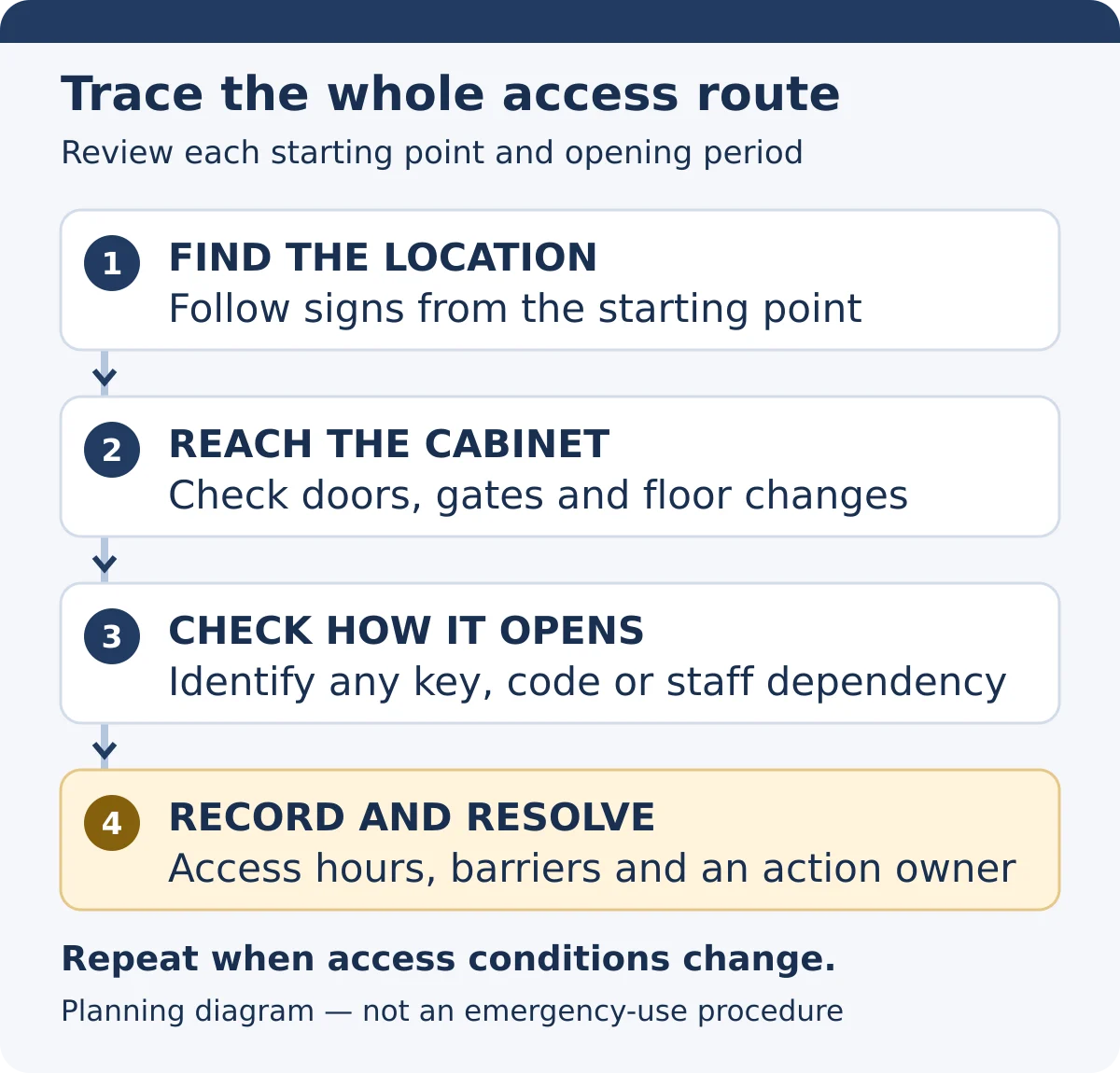
For your site review, choose named starting points such as the loading entrance, far office corridor or sports changing area. Walk towards each proposed location using the signs a visitor would actually see. Record turns, floor changes, obscured signs and any point where the next direction is unclear. Review physical reach and cabinet operation with the people responsible for accessibility.
Do not approve a position solely because it looks central on a drawing. Have the team review the actual walking route, the intended users and the conditions at that location.
Source: Resuscitation Council UK: 2025 guidance on AED location and signs (UK scope)
Check what changes when reception closes
A location can be convenient during office hours and inaccessible during an evening activity. Make separate entries for occupied periods with different door, gate or reception arrangements. Include maintenance closures and temporary event barriers where relevant.
Use the following as observation prompts. Record the condition found rather than assuming that a staff member, key or access card will always be available.
- Can someone reach the proposed cabinet from each occupied zone without entering a room that may be locked?
- Do security doors, turnstiles or access-controlled lifts change the route for visitors or contractors?
- Are signs and the cabinet readable during the hours when that area is used?
- If the normal route is closed, has the responsible team agreed and marked an alternative?
Review the cabinet as part of the route
RCUK’s cabinet consensus recommends unlocked cabinets for immediate access and explains that obtaining or operating a lock code can delay access. Its discussion of The Circuit concerns the UK defibrillator network. Do not assume that a UAE emergency call handler holds your cabinet code or that a UK registration process applies to your site.
Ask the responsible team to resolve any security proposal that adds an access barrier. Document how the cabinet opens and who maintains it. Confirm changes to a cabinet with its manufacturer or installer; a purchasing worksheet is not an instruction to alter locks or wiring yourself.
Source: Resuscitation Council UK: cabinet-access consensus, updated August 2024
Match the position to the device and cabinet instructions
ZOLL’s maintenance guidance says to follow the manufacturer’s operating and storage limits, including the conditions for consumables. A suitable range for one AED does not establish the limits for another model or its pads and battery.
For an outdoor position or an unconditioned room, ask the supplier how the proposed cabinet and installation keep the exact equipment within its documented limits. Record the relevant manual sections and how conditions will be checked. A weather-resistant enclosure alone is not evidence of temperature control.
Include cabinet mounting, physical access, any power requirements and ongoing cabinet checks in the installation brief. Let the responsible installer and site reviewers confirm the applicable requirements. This guide gives no universal mounting height or outdoor temperature guarantee.
Source: ZOLL: manufacturer guidance on AED storage and consumables
Record the route, condition and unresolved action
Use one record per starting point and operating condition. This is an original editorial worksheet, not an authority inspection form. Agree the exercise with the site team so that it does not interrupt emergency availability; use suitable training arrangements and do not activate a clinical device or open sealed supplies just to test a route.
If the team times a planned exercise, record its start and finish definition, observed conditions and any delay. A route observation is not the same as time from a cardiac arrest to treatment. This guide sets no universal pass time, coverage radius or square-metre formula. Refer findings to the people responsible for the site response plan.
| Record | Observation to capture | Decision or owner |
|---|---|---|
| Starting point | Named room or zone, floor and route to the proposed AED. | Location reviewer and drawing reference. |
| Operating condition | Date, occupied hours, reception cover and door or gate state. | Person confirming access arrangements. |
| Wayfinding | Signs seen from the route; missed turns or obstructed views. | Sign changes and person responsible. |
| Cabinet access | How the cabinet is reached and opened; any dependency on a key, code or person. | Access problem, agreed action and owner. |
| Environment | Device, consumable and cabinet limits; evidence for the proposed position. | Manual references and installation reviewer. |
| Follow-up | Remaining barriers, proposed location changes and review result. | Action due date and repeat-check record. |
Use the findings to review locations and quantities
Consider an illustrative office with a proposed AED inside a staffed reception. An evening event uses a separate entrance after that reception is locked. The daytime route review does not establish access for the event. Record the evening barrier and ask the responsible team to review a different position, access arrangement or additional equipment as appropriate.
For a multi-floor building, repeat the assessment from relevant areas on each floor and include the actual vertical route. Keep the reason for the selected locations and equipment quantity with the site plan. A generic one-per-floor statement is not a substitute for that decision.
After installation, verify the agreed routes and signs against what was delivered. Assign an owner and backup for access information, cabinet checks and equipment records. Revisit the placement decision when room use, occupancy hours, partitions, security access or equipment location changes. Link the plan to the model-specific maintenance record.
Buyer questions
Is one AED on every floor always the right plan?
This guide does not establish a device count. Review the actual occupied areas, access routes, barriers and site requirements with the responsible team. Keep the rationale for the selected locations and quantity.
Can an AED stay in a reception area that closes at night?
Check whether any part of the site remains occupied when reception is inaccessible. Record those hours and ask the responsible team to resolve the gap before relying on that position for those occupants.
Does a weatherproof cabinet prove an AED can be stored outdoors?
Check the environmental limits for the exact AED, consumables and cabinet. Ask for evidence that the proposed installation meets those limits under the expected conditions; weather protection and temperature control are separate questions.
What does a timed route exercise demonstrate?
It records a defined exercise under its observed conditions. It does not certify a clinical response time, predict survival or establish compliance. Keep the start and finish definition, delays, operating conditions and follow-up decisions.
Are the linked UK cabinet recommendations UAE legal requirements?
No. The sources are identified as UK guidance. Confirm requirements for your own facility through the responsible local reviewers, and do not assume that UK cabinet-code or registration arrangements operate in the UAE.