Maintenance
AED Maintenance in the UAE: Build a Model-Specific Checklist
By NeoPulse AED Team · Published · Updated
Prepared with AI assistance using the linked sources. Read our editorial policy.
Quick answer
Build your AED maintenance checklist from the current instructions for the exact model and its accessories. Record the checks, expected status, due dates and response to faults, then assign a person to follow up. Do not assume that every AED has the same ready light, testing procedure, replacement interval or servicing requirement. Confirm any additional facility requirements with the responsible organization.
What changed in this maintenance guide
Updated 23 September 2026: this guide replaces earlier unsupported UAE inspection rules, fixed replacement thresholds and blanket service promises. It now explains how a facility manager can organize a model-specific maintenance record. The original publication date and article address are retained.
The checklist is an administrative planning aid, not a device service procedure or proof of regulatory compliance. Obtain the applicable manufacturer instructions and any facility-specific requirements before setting the schedule.
Updated 25 September 2026: added a manufacturer-notice record and consolidated the overlapping maintenance article into this guide. Existing links to the older article now lead here.
Start with the manual, not a generic quarterly calendar
ZOLL advises owners to use manufacturer instructions for inspections and environmental limits, and notes that pad and battery life differs by manufacturer and model. Those principles help define what your own checklist must reference. The US state-law discussion on that page should not be treated as UAE requirements.
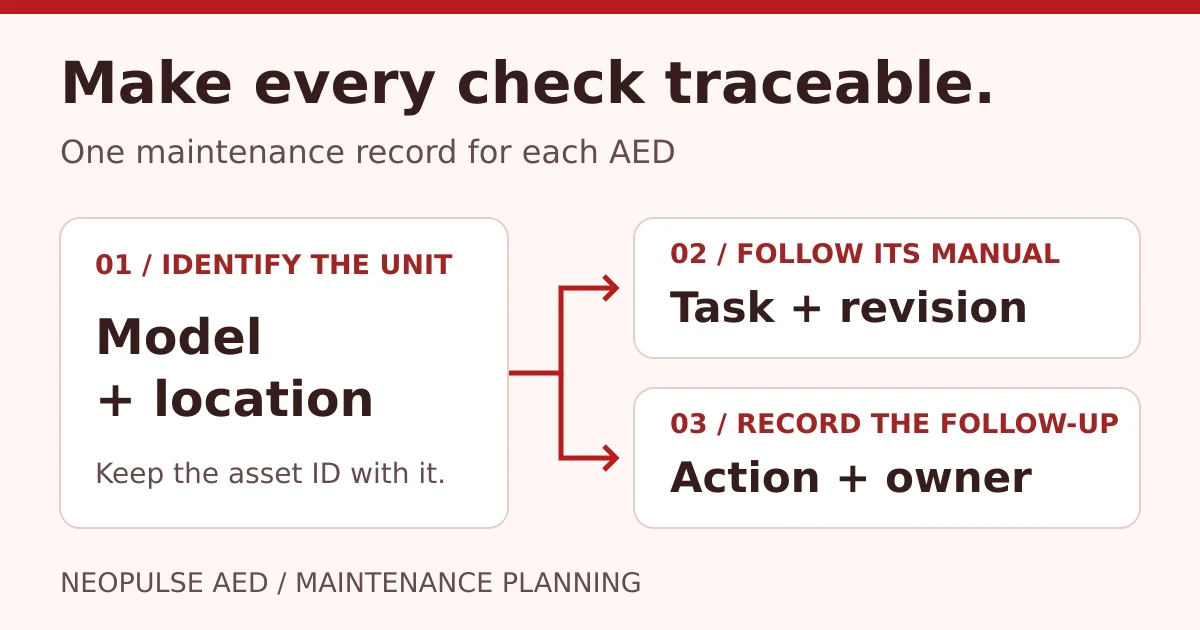
Create a file for each device with its manufacturer, model, serial number, location and manual revision. Ask the supplier to identify the instructions that apply to your unit and accessories. Keep the reference beside the task it supports, so the next person can understand why that task is scheduled.
If your organization wants a quarterly management review, use it to review records, unresolved actions and upcoming purchases. Do not assume that a quarterly review replaces the individual device checks specified by its instructions.
Source: ZOLL: routine inspection and AED maintenance guidance
A ready indicator is model-specific
For example, the Philips HeartStart HS1 M5066A Owner’s Manual, Edition 13, describes a blinking green light as standby readiness and a solid green light as use in progress. Its maintenance chapter also says that manual calibration is unnecessary and cautions that unnecessary battery-insertion tests consume battery power. These are examples from that model and edition, not NeoPulse instructions.
A universal checklist saying solid green means ready or power on every month can therefore be misleading. Have the responsible person copy the expected observation and required action from the applicable current manual. Confirm the latest revision with the manufacturer; the linked Philips example was published in January 2014.
Source: Philips HS1 M5066A Owner’s Manual, Edition 13: controls and chapter 5 (PDF)
Fields to include in your maintenance record
Set up the following fields before assigning checks. This is a suggested record structure; the actual observations, frequency and acceptance criteria must come from the instructions applicable to your device.
| Record field | What to enter | Why it helps |
|---|---|---|
| Device and location | Asset identifier, manufacturer, model, serial number and exact location. | Connects the record to the unit actually checked. |
| Instructions used | Manual title, revision, relevant section and any confirmed facility requirement. | Makes the basis for each task traceable. |
| Task and timing | Check to perform, its due date and the source for the interval. | Separates device instructions from an internal management-review date. |
| Expected and observed status | The model-specific expected observation and what was actually observed. | Avoids a generic tick box that hides uncertainty. |
| Accessories and dates | Exact pad and battery part numbers, applicable label dates and replacement rules from the instructions. | Provides the details needed for a compatible replacement enquiry. |
| Action and owner | Issue found, assigned person, service reference and follow-up date. | Keeps an unresolved fault visible until the action is completed. |
| Closure record | Work completed, supporting service record, reviewer and completion date. | Shows what changed rather than merely recording that a visit occurred. |
Order replacements by part number and documented compatibility
The FDA explains that pads and batteries are part of the AED system and lists approved accessories alongside compatible devices in its US records. This illustrates the need to check the exact combination; it does not establish UAE approval or compatibility for a NeoPulse accessory.
When requesting replacements, send the device model, existing accessory part number and relevant label information. Ask the supplier to confirm compatibility in writing and provide the applicable instructions. Keep a purchase lead-time reminder separate from the actual expiry or replacement rule; an internal ordering reminder is not a new manufacturer limit.
Give faults and overdue actions an owner
Write down who receives a reported fault, who contacts the supplier and who checks that the response has been completed. If an indicator is unclear, a component is damaged or a date cannot be read, record that uncertainty and use the applicable troubleshooting instructions and manufacturer support. Do not mark an unresolved observation as a pass.
Keep device inspection, cleaning, repair and return-to-service procedures in the manufacturer-controlled instructions. This guide does not add a repair method, cleaning chemical, battery-percentage threshold or fixed early-replacement rule. For a service visit, ask the provider to identify the procedure used and supply the resulting record.
For a shared or multi-site fleet, give each unit a named owner and a backup contact. A central summary can show open actions and upcoming due dates while the underlying records retain the device-specific detail.
Record manufacturer notices and follow-up actions
Include product notices in the device file as well as routine checks. The FDA explains that, in the US, a medical-device recall can involve a correction or removal. The action depends on the specific notice; the term alone does not tell an owner what to do. This source explains US terminology, not UAE reporting requirements.
For your AED, obtain the applicable notice from the manufacturer or authorized support provider. Match the listed model and any serial, lot or software-version criteria to the actual unit. Ask for clarification if the match is unclear, and follow the notice instructions rather than improvising an update or repair.
Use the record fields below to keep the notice and its outcome with the unit. The record supports follow-up; it does not establish that a particular model is affected by a recall.
- Notice reference and date, issuing organization and source link or saved document.
- Affected device identifiers and the evidence used to determine whether the notice applies.
- Required action, responsible person and the deadline specified in the notice, where provided.
- Manufacturer or service response, completed work and documented closure.
Make the maintenance quotation measurable
Ask the proposed provider to list the models and sites covered, visit frequency, tasks, exclusions and charges. Clarify whether consumables, call-outs, shipping, training or temporary equipment are included or separately quoted. A single annual price is difficult to compare without that scope.
If remote monitoring is offered, ask which exact device signals it receives, who reviews alerts and how connectivity failures are handled. Get those capabilities and response commitments in the written proposal. Do not assume that a dashboard proves that the cabinet is accessible or that every physical check has been completed.
- Keep the task schedule with its source instructions.
- Record unresolved questions and the person responsible for each.
- Review the completed work and supporting record before closing an action.
- Confirm model coverage, parts and response terms before accepting a service proposal.
Buyer questions
Is there one quarterly maintenance schedule for every AED in the UAE?
This guide does not establish a universal UAE schedule. Use the current instructions for your exact device and confirm any additional requirements with the organization responsible for your facility. An internal quarterly review is separate from those checks.
Should staff switch on the AED just to complete a checklist?
Use the checking method specified in the applicable manual. Do not add a generic power-on or battery-removal step simply because a template includes it.
Can the same form cover a mixed fleet?
The record structure can be shared, but each device needs its own identifiers, applicable instructions, expected observations and due dates. Do not copy the settings from one model into another.
Does a service contract automatically include pads, batteries and a loan device?
Confirm those items in the written quotation. Record part coverage, exclusions, charges and any response or temporary-equipment terms before relying on them.