Hospitality Procurement
AEDs for UAE Hotels: Access, Shift Cover and Purchasing Checks
By NeoPulse AED Team · Published · Updated
Prepared with AI assistance using the linked sources. Read our editorial policy.
Quick answer
For a UAE hotel AED purchase, first confirm the current requirements for the property, then review equipment access across shifts, the exact device configuration and responsibility for checks. A guest-room count alone cannot resolve those questions. Prepare one record covering daytime, overnight and event use, and ask suppliers to identify what their offer includes and what still needs verification.
What has changed in this hotel guide
Updated 7 October 2026: removed unsupported star-rating rules, guest-room ratios, penalties, clinical statistics, NeoPulse device features, package prices and service promises from the earlier article. The original 1 June 2026 publication date and existing address are retained.
This guide is a purchasing and handover aid for hotel procurement, security and facilities teams. It does not certify compliance, prescribe a clinical response or establish a universal number of devices. Ask the property’s responsible safety and clinical advisers to review its equipment and response arrangements.
Check the status of the rule, not just its publication date
Dubai Administrative Resolution No. (50) of 2022 repealed Administrative Instructions No. (1) of 2007 concerning first aid in hotel establishments. The resolution was issued on 3 August 2022 and took effect that day. An online copy of the older instructions should therefore not be treated as a current rule on its own.
That repeal does not establish that a hotel has no AED or first-aid obligations. It is one document, not a complete assessment of current classification, licensing or other requirements. Have the responsible adviser confirm what applies to the specific property. The official English translation states that the Arabic text prevails for interpretation and application.
Source: Dubai Legislation Portal: Administrative Resolution No. (50) of 2022, Articles 1–2
Keep a property-specific requirements record
DET provides an official hotel-classification renewal service for Dubai. Use the relevant authority process and the hotel’s own current classification records when arranging the review. The public service page is not an AED equipment schedule, and this guide does not claim access to the hotel’s portal records.
Record the authority, document version, property scope, reviewer and any unresolved questions. For a hotel in another emirate, obtain the applicable local requirements rather than reusing a Dubai conclusion. Keep any hotel-group policy or insurer condition labelled separately from a legal requirement.
Source: Dubai Department of Economy and Tourism: hotel-classification renewal service
Walk the access routes across shifts and event use
Ask the property team to review the same areas during normal guest activity, overnight operations and a representative event setup. Include changes to doors, lifts, room access and staffing. A device marked on a floor plan does not answer who can reach it when a room is closed.
Use the original worksheet below to record questions and agreed actions. The rows are review prompts, not mandatory device locations or an equipment-count formula. Record actual routes and observations; leave an untested arrangement marked as unresolved.
| Area or change | Question to resolve | Record at handover |
|---|---|---|
| Reception and security | Does equipment access depend on one person, desk or locked room? | Agreed access route, duty owner and cover during breaks. |
| Guest floors and separate wings | Do doors, lifts or access permissions change overnight? | Routes reviewed with the property team and outstanding barriers. |
| Gym and spa closing | What happens to access when these rooms close? | After-hours arrangement and the team responsible for it. |
| Pool and outdoor venue | Do the proposed location and cabinet suit the actual conditions? | Model-specific storage assessment and facilities reviewer. |
| Ballroom and events | Does a temporary layout or contractor handover change access? | Event setup review and named hotel/organiser responsibilities. |
| Refurbishment or equipment removal | Who reviews temporary changes and tells the next shift? | Agreed interim arrangement, action owner and review date. |
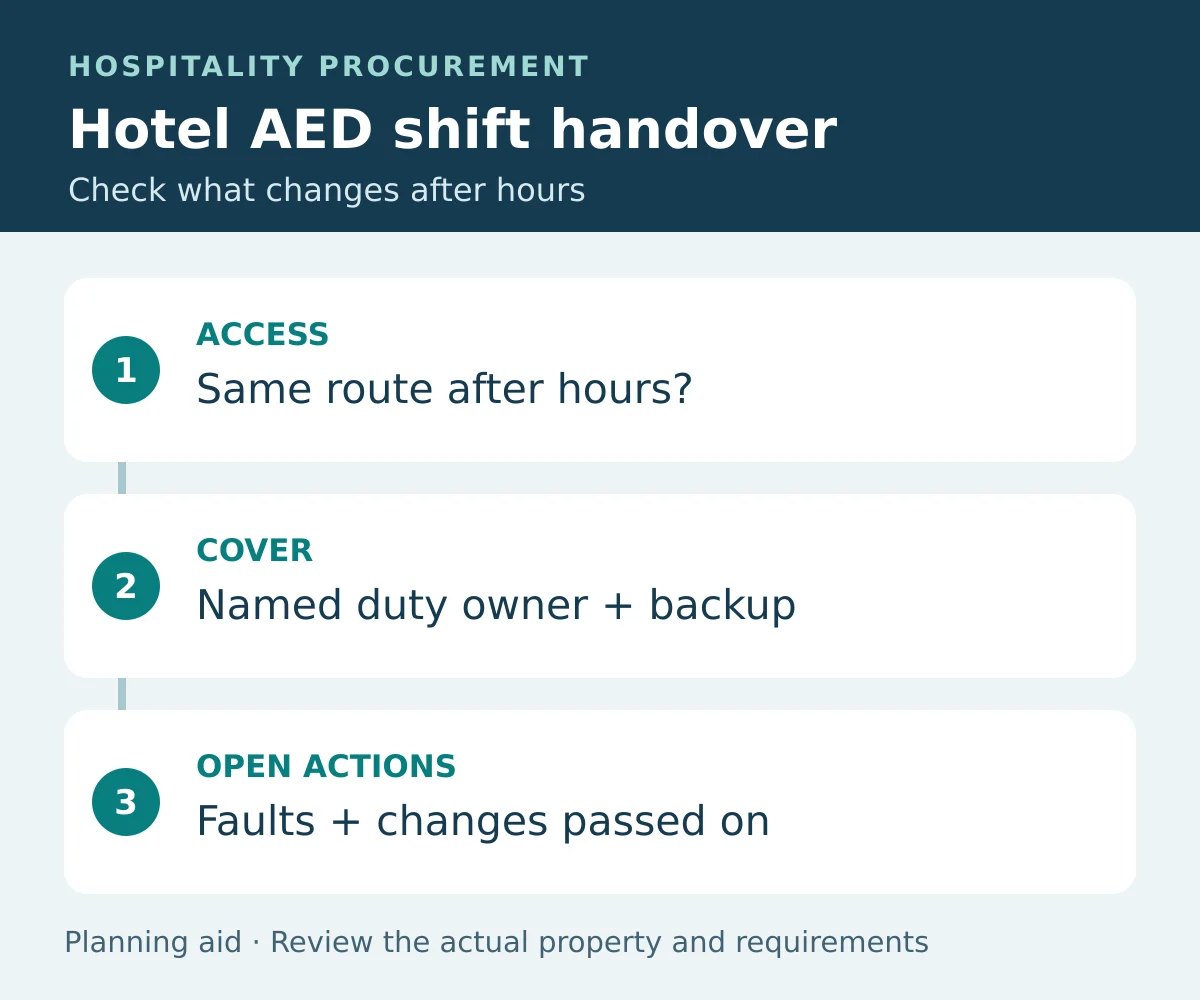
Make the handover usable for the next duty team
Name the programme owner, the duty contact and a backup. Agree who maintains the access record, tracks equipment issues and follows up unfinished actions. Include overnight teams, outsourced security and temporary event staff in the responsibility discussion where they are involved.
Have the responsible reviewer identify the training and qualification requirements for the roles expected to respond. Keep a supplier demonstration, an equipment handover and a recognised training course as separate items in the quotation; do not assume that one provides the others.
- Location changes: identify the equipment and the revised access arrangement.
- Open issues: record the fault or missing item, responsible person and agreed next action.
- Staff changes: transfer records and confirm who takes ownership on the next shift.
- Event changes: agree responsibilities before the event team leaves.
Review storage and checks against the exact model
ZOLL’s maintenance guidance directs owners to manufacturer instructions for inspection and environmental limits, including storage conditions for consumables. It also points to battery and pad expiry information. This is manufacturer guidance, not a UAE hotel inspection schedule.
For a poolside, beach-club or outdoor proposal, request the quoted model’s operating and storage limits and the cabinet documentation. Ask the facilities reviewer to assess the actual location. Do not accept an “outdoor” label as the whole assessment.
Build the check record from the device instructions and applicable requirements. Assign responsibility for expiry dates, faults, replacements and handover after use. Confirm any temporary replacement arrangement in writing; this guide does not promise a loan unit or a fixed service interval.
Source: ZOLL: manufacturer instructions, storage conditions and consumable checks
Ask what a monitoring claim actually covers
If a quotation proposes remote monitoring, ask the supplier to identify the exact device, cabinet, software and service involved. Request a written description of which events are detected, how notifications reach the duty team, and what happens during a power or network interruption. A cabinet-open alert and a device-readiness report answer different questions.
Arrange an agreed acceptance demonstration with the supplier and the hotel’s technical team. Record subscriptions, connectivity, support responsibilities and the handover of access. Do not mark an integration accepted just because a brochure says “connected”. No NeoPulse monitoring capability is established by this guide.
Match the delivered equipment to the reviewed offer
The US FDA describes batteries and electrode pads as necessary parts of an AED system and publishes device and accessory information. That is US regulatory information; it does not establish UAE registration or approval of a particular hotel package.
For the proposed equipment, request manufacturer instructions, model and accessory identifiers, local regulatory evidence and written support terms. At handover, reconcile the delivered serial numbers, accessories and documentation with the reviewed order. Record installation, signage, training and ongoing checks as separate responsibilities, including anything excluded from the price.
Use the related quotation and maintenance guides below for the detailed purchasing records. Confirm price, availability and timing for the actual order rather than relying on a generic hotel package description.
Buyer questions
Does the repeal of the 2007 Dubai instructions mean hotels have no AED obligations?
No such conclusion follows from that document alone. Ask the property’s responsible adviser to confirm current classification, licensing and other applicable requirements. Keep the current references and the review decision with the purchasing brief.
Can we calculate the required AED count from the number of guest rooms?
This guide establishes no guest-room ratio. Review the property’s applicable requirements, layout, actual access routes, operating hours and response arrangements with the responsible team before agreeing quantities.
What should be recorded for a gym that closes at night?
Record how the agreed equipment access arrangement works after the gym closes, who owns that arrangement and any unresolved barrier. Include the next duty team in the handover.
Does a cabinet alarm prove the AED is monitored remotely?
Ask for separate evidence of the cabinet alarm, device status reporting, connectivity and notification service. Have the supplier demonstrate the agreed functions and document the hotel’s responsibilities.
Can one maintenance timetable be copied across different hotel AED models?
Use each model’s manufacturer instructions and applicable requirements to build its record. Track the relevant consumables, checks and responsible people rather than assuming every unit has the same schedule.