Workplace Planning
AEDs for Onshore Oil and Gas Sites in the GCC
By NeoPulse AED Team · Published
Prepared with AI assistance using the linked sources. Read our editorial policy.
Quick answer
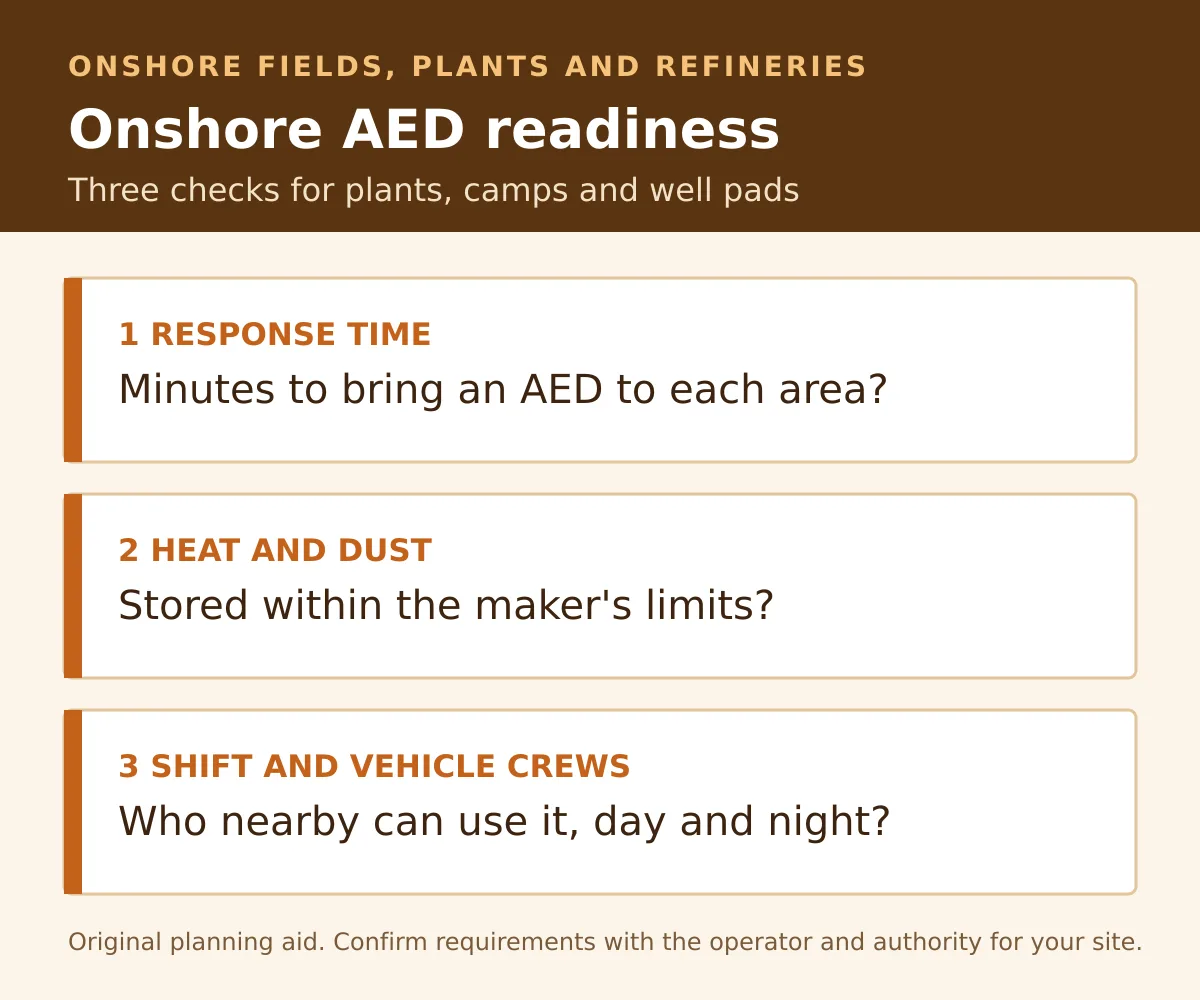
On an onshore oil or gas site, the ambulance may be a long drive away, so the first shock usually depends on an AED already on site and a trained worker nearby. Map how many minutes it takes to bring an AED to each process unit, control room, camp and remote well pad; US OSHA guidance aims for a response within three to five minutes. Store the device within the manufacturer’s temperature limits, train people on every shift and in field vehicle crews, and link the AED to the site’s medical emergency plan. GCC operators set their own occupational health standards, so confirm the requirement for your concession with the operator’s HSE and medical teams.
Why onshore sites need their own AED plan
A refinery or gas plant can look like any large industrial site, but many onshore fields in the Gulf are spread across open desert, with well pads, pipeline stations and camps a long drive from the nearest hospital. Workers also travel between locations, so the nearest AED may be in a building that is empty for most of the day.
US OSHA publication 3185, Saving Sudden Cardiac Arrest Victims in the Workplace, says AEDs should be placed so that a response can happen within three to five minutes. It names remote sites and outdoor worksites among the places where emergency medical services may be delayed, and notes that survival is far lower when workers wait for an ambulance than when a shock is given immediately.
Source: US OSHA 3185: Saving Sudden Cardiac Arrest Victims in the Workplace (PDF)
Typical onshore locations to review
Walk the site with the HSE lead and list every place where people work, sleep, eat or wait. Then record how long it takes for a trained person to bring an AED to each one, by foot or by vehicle, at day and night staffing levels.
- Process units, compressor stations and tank farms, where access may be restricted by permits or gas detection.
- Control rooms, workshops, warehouses and administration buildings.
- Accommodation camps, dining halls, gyms and prayer areas used by large crews after work.
- Remote well pads, drilling rigs, pipeline stations and gathering centres reached by field vehicles.
- Gatehouses, bus pick-up points and contractor laydown yards during shutdowns and turnarounds.
UAE, Qatar, Oman and Saudi Arabia
National oil companies and their partners issue occupational health and HSE standards to contractors, and those standards usually set the medical and first aid provision on a concession. We did not find a public regulator rule in the UAE, Qatar, Oman or Saudi Arabia that names AEDs for onshore oil and gas sites when this guide was written. Ask the operator for the clause that applies and keep it with the equipment record.
In Abu Dhabi, ADOSH-SF Code of Practice 4.0 on first aid and medical emergency treatment says employers should consider an AED programme based on risk assessment or authority mandates, with written responsibilities, physician oversight, training and manufacturer-directed maintenance. In Saudi Arabia, the Ministry of Human Resources and Social Development summarises the employer duty to provide first aid cabinets and to cover transport to treatment for work injuries; it does not name AEDs, so the operator standard and risk assessment still decide.
The IPIECA medical emergency response and primary healthcare guideline is an industry reference many operators use to plan emergency medical response across onshore and offshore assets. Use it to frame the discussion, not as a substitute for the operator’s own requirement.
Source: ADPHC: CoP 4.0, first aid and medical emergency treatment (PDF); Saudi HRSD: health and safety at work; IPIECA: medical emergency response and primary healthcare guideline
Heat, dust and storage in the desert
Inland Gulf summers can approach or exceed the upper storage temperature in an AED manual, and the inside of a parked vehicle or an unshaded steel cabinet gets hotter than the outside air. Pads and batteries are usually the parts most sensitive to heat.
Before choosing a location, read the exact model’s operating and storage temperature ranges and its dust and water protection rating. Prefer air-conditioned buildings, shaded or insulated cabinets and a routine for moving vehicle AEDs indoors when vehicles are parked. Record the decision and the check schedule in the site’s equipment log.
Onshore site AED worksheet
Use this worksheet with the site HSE lead, the occupational health provider and the operator’s medical adviser. It is an original planning aid, not an operator or authority form.
| Area | What to record | Question for the review |
|---|---|---|
| Requirement | Operator standard clause, contract term or risk assessment that sets AED provision. | Which document applies to this concession or contract? |
| Response time | Measured minutes from each AED to each work area, by foot or vehicle. | Can a trained person bring an AED to every area within the target time? |
| Remote crews | Which field vehicles, rigs and well-pad teams carry an AED. | What do crews working alone or in pairs carry? |
| Storage | Manufacturer temperature limits, cabinet type, shade or air conditioning. | Is each AED kept within its documented limits all year? |
| People | Trained first aiders on each shift, language of training, refresher dates. | Who can use the AED at night, during shutdowns and on rest days? |
| After use | Spare pads and batteries, medical evacuation route, contact for replacement. | How is the AED returned to service, and how long until hospital care? |
What to ask an AED supplier for an onshore contract
Ask for the exact model’s temperature, dust and water ratings from the manufacturer’s documents, and whether the voice prompts and screen can be set to the languages your crews speak. Ask whether a carry case suited to vehicles and a cabinet suited to outdoor or plant locations are available for that model.
Ask how many spare pads and batteries suit your number of devices and rotation schedule, whether trainer units are available for toolbox drills, and who replaces consumables after use. NeoPulse can quote AEDs, cabinets, spares and crew training for onshore and offshore sites in the UAE and the wider GCC; send the site details through the quote form.
Buyer questions
Is an AED required at an onshore oil and gas site in the UAE?
We found no public UAE regulator rule naming AEDs for onshore oil and gas sites. The requirement usually comes from the operator’s HSE or occupational health standard, the contract and the site risk assessment. In Abu Dhabi, CoP 4.0 asks employers to consider an AED programme based on risk assessment.
How many AEDs does an onshore plant or field need?
There is no single ratio. Start from the time it takes to bring an AED to each work area. OSHA guidance aims for a response within three to five minutes, so large plants and spread-out fields usually need several units, including some in field vehicles.
Can an AED be kept in a field vehicle in the desert?
Only within the manufacturer’s storage limits. A parked vehicle can get much hotter than the outside air, so agree a routine for moving the AED indoors or into an insulated case, and check pads and battery more often.
Who should be trained to use the AED on an onshore site?
First aiders on every shift, plus members of crews who work away from the main plant, such as well-pad, pipeline and maintenance teams. Train them on the exact model the site uses, with refreshers.
Does this guide cover offshore platforms?
No. Offshore installations have different access and evacuation problems. See our separate guide to AEDs on offshore oil and gas platforms in the GCC.