Workplace Planning
AEDs for UAE Construction Sites: Planning and Handover
By NeoPulse AED Team · Published · Updated
Prepared with AI assistance using the linked sources. Read our editorial policy.
Quick answer
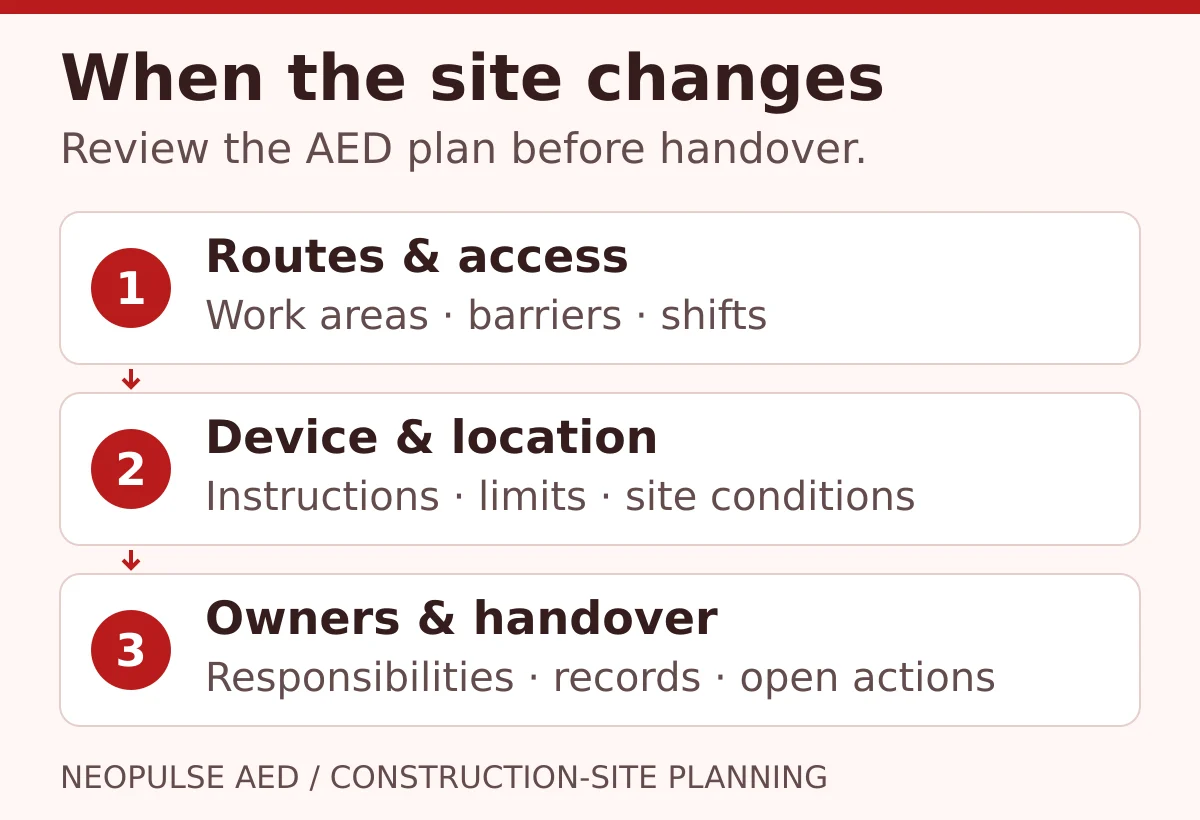
Start with the construction project’s emergency plan and the requirements that apply to its location. Ask the responsible safety and medical reviewers to determine AED provision, placement and responder arrangements. Before ordering, document the proposed device, storage conditions, access routes and handover responsibilities. Review those decisions when work areas, routes or shifts change. For outdoor work, review heat-stress prevention separately from AED provision and equipment storage.
What changed in this construction-site guide
Updated 27 October 2026: added a heat-planning review and consolidated the older outdoor-worker summer article here. The older article included unsupported survival percentages and outdoor-product promises. The new section separates worker heat protection from AED provision and device storage; the original publication date is retained.
Updated 26 September 2026: this guide replaces unsupported legal thresholds, fines, clinical statistics, model approvals and outdoor-performance promises in the earlier article. It also corrects the first-aid code reference: the ADPHC catalogue lists first aid under CoP 4.0; CoP 47.0 concerns machine guarding. The original article address and 1 June 2026 publication date are retained.
Use this as a procurement and handover worksheet for discussion with your project’s responsible reviewers. It does not determine legal compliance, prescribe emergency treatment or certify that a particular AED is suitable for your site.
Confirm the applicable requirements before specifying equipment
For Abu Dhabi, ADOSH-SF CoP 4.0, First Aid and Medical Emergency Treatment, Version 4.0 dated 15 July 2024, applies to employers in the emirate. Section 3.4 says employers should consider an AED programme based on risk assessment and/or relevant authority mandates. Its programme provisions address written responsibilities, a DOH-licensed physician’s oversight, integration with emergency arrangements, training for the device, manufacturer-directed maintenance and quality assurance.
The code also addresses accessible placement and response time. Read the complete applicable provisions with your project’s safety and medical reviewers; a product order alone cannot satisfy the programme considerations. This Abu Dhabi document is not evidence of identical requirements in Dubai or the other emirates.
Record the project location, responsible authority, applicable document and revision, reviewer and unresolved questions. Ask for the source of any claimed headcount threshold, equipment quantity or inspection interval before including it in a tender. Do not carry a rule from another project into the new specification without checking its applicability.
Describe the working site, including access barriers
Give the reviewer a current marked-up site plan rather than only a total floor area. Include occupied work zones, changing levels, entry controls and the routes people can actually use. A straight line on a drawing does not show a locked gate, a closed stair or a work zone that moves between shifts.
Use the approved emergency plan to assess proposed locations and quantities. Record how access was checked, who reviewed it and what remained unresolved. This worksheet deliberately supplies no universal device-per-square-metre formula.
- Identify active work areas and the periods when each is occupied.
- Mark proposed AED locations and routes from representative work areas.
- List gates, temporary barriers, level changes and access permissions that need review.
- Include night shifts, subcontractor handovers and remote work zones in the brief.
Match the actual location to the device instructions
ZOLL’s storage guidance directs owners to manufacturer operating and storage temperature ranges, humidity and pressure guidance, and the storage limits of consumables. It also advises following manufacturer temperature guidance for outdoor storage. These are useful questions for a specification; they do not verify any NeoPulse model’s environmental limits.
Ask for the current instructions for the exact quoted AED, pads and battery. Record the intended location’s conditions and ask the supplier to explain how the proposed equipment and enclosure meet the documented limits. Request temperature and humidity limits separately from dust and water protection; do not treat an IP label or the word outdoor as a complete suitability assessment.
If the proposal relies on a powered enclosure, ask who provides power, checks its operation and handles an interruption. Keep those answers in the written scope. Do not assume an enclosure includes cooling, monitoring or an automatic alert service.
Source: ZOLL: AED placement, storage and manufacturer guidance
Keep heat-stress prevention and AED planning connected
Buying an AED does not replace a heat-stress programme. The site review needs to address worker protection, emergency arrangements and the conditions in which the equipment will be kept.
For Abu Dhabi, ADOSH-SF CoP 11.0, Safety in the Heat, Version 4.0 dated 15 July 2024, addresses risk assessment, acclimatization, environmental assessment, work/rest arrangements, drinking water, cooling or rest areas and training. Its scope covers employers with staff working in high-temperature environments in the emirate. Check the applicable requirements for the actual site rather than presenting this as one rule for every UAE workplace.
Keep the heat-stress plan and the AED location record linked in the site handover. Use the questions below to assign owners and unresolved actions; they are a planning aid, not instructions for treating heat illness.
- Who reviews the heat-stress plan before hot-weather work or a change of work area, and where is the current version kept?
- Have the responsible reviewers checked how staff call for help and how emergency responders reach each occupied work area?
- If an AED location moves with a rest area or site office, who rechecks access, the recorded environmental conditions and the device instructions?
Source: ADPHC: CoP 11.0, scope, training and heat-stress programme requirements (PDF)
Use a site handover worksheet
Complete one record for each proposed location and link it to the current site-plan revision. The fields below are an original planning aid, not an authority-issued form. Assign an owner to unanswered items so an incomplete supplier response does not become an assumed inclusion.
| Review item | Evidence to retain | Handover question |
|---|---|---|
| Site and access | Plan revision, proposed location and access review. | Who rechecks this when routes or work areas change? |
| Equipment identity | Manufacturer, exact model and accessory part numbers. | Do delivered items match the approved proposal? |
| Environment | Applicable instructions and the location assessment. | Who resolves a mismatch or an enclosure problem? |
| People and training | Programme owner, shift contacts and agreed training scope. | Who confirms the responder arrangements for each shift? |
| Maintenance and support | Device-specific schedule, service contact and open actions. | Who owns checks, replacements and fault follow-up? |
| Transfer or relocation | Revised location record, receiving owner and handover date. | Have access, conditions and staff information been reviewed? |
Revisit the plan when the construction phase changes
Build review points into your project handovers. A new floor, relocated site office, revised gate arrangement or change of contractor is a practical reason to check whether the recorded AED location and responsibilities still describe the working site.
For example, if a site office moves, record the proposed new location and receiving owner. Have the responsible reviewers reassess access and environmental suitability, update the site plan and staff information, and close the handover actions. Retain the earlier record so the change can be traced.
Keep formal responder training separate from supplier equipment familiarization. Ask the training provider and project reviewers to agree the course, intended participants, assessment and refresher arrangements. Use the linked maintenance and quotation guides for the detailed device record and purchasing comparison.
Buyer questions
Does this guide establish one UAE-wide AED rule for every construction site?
No. It identifies an Abu Dhabi primary source and provides planning questions. Have the responsible project reviewer confirm all requirements that apply to the site’s jurisdiction and activities.
Can I decide the number of AEDs from site area alone?
Use the site assessment and applicable requirements, including actual routes, occupied areas and shift arrangements. This guide supplies no device-per-area formula.
Does an outdoor cabinet prove the proposed AED is suitable?
Ask for documented limits for the exact device, accessories and enclosure, and compare them with the proposed location. Confirm any power, temperature-control and support assumptions in writing.
What should change when the AED moves with the site office?
Review the location and access assessment, site plan, receiving owner and staff information. Record the handover and resolve open questions before treating the new arrangement as approved.
Does buying an AED complete an outdoor-site heat-safety plan?
No. Have the responsible site reviewers address heat-stress prevention and emergency arrangements separately from the AED purchase. Keep the heat-stress plan linked to the equipment location and handover records, with named owners for unresolved questions.