Workplace Planning
AEDs for Offshore Oil and Gas Platforms in the GCC
By NeoPulse AED Team · Published
Prepared with AI assistance using the linked sources. Read our editorial policy.
Quick answer
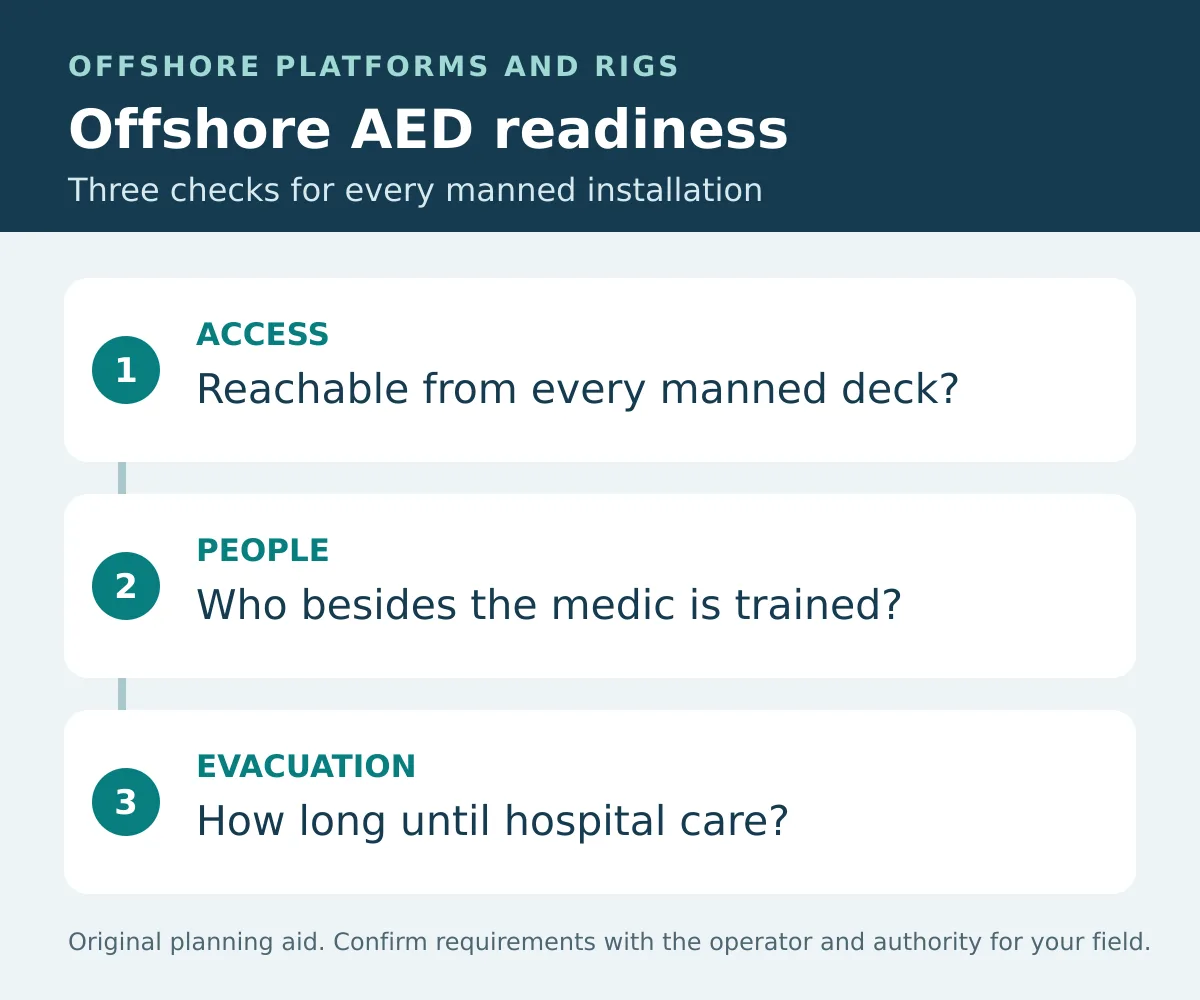
On an offshore platform or rig, help from shore can take hours, so the AED and the people trained to use it have to be on the installation. Plan at least one AED that can be reached quickly from every manned area, train more crew than the medic alone, check the device on a set schedule and link it to your medical evacuation plan. GCC operators set their own offshore medical standards, so confirm the requirement for your field with the operator's HSE and medical teams; public regulator guidance from the UK and the US shows what inspectors look for.
Why offshore AED planning is different
Offshore crews work far from hospitals. In a 2023 safety alert, the US Bureau of Safety and Environmental Enforcement (BSEE) reported that medical evacuations from the offshore facilities it reviewed took an average of 6.8 hours to reach onshore medical care. The same inspections found AEDs on all but one facility, but the equipment was not easily accessible and only medical staff had been trained to use it.
That is the planning problem in one sentence: having an AED on board is not the same as having one that a nearby crew member can reach and use in the first minutes. BSEE recommended assessing AED placement, documenting AED status monthly and evaluating probable response times for medical support.
Source: BSEE Safety Alert 469: medical evacuation and emergency hazards (PDF)
What offshore inspectors look for
The UK Health and Safety Executive's Offshore First Aid and Medical Provision Inspection Guide (April 2026) asks whether emergency equipment such as defibrillators is readily accessible, suitably located, routinely maintained, inspected and tested. It also asks whether offshore medics and offshore first aiders are trained and familiar with the exact types of defibrillator provided at the site.
The guide sits alongside HSE's approved code of practice L123 on health care and first aid on offshore installations. These are UK documents and do not apply in GCC waters, but they are a public, current benchmark that international operators and contractors in the Gulf often recognise.
Source: UK HSE: Offshore First Aid and Medical Provision Inspection Guide (PDF); UK HSE: L123, health care and first aid on offshore installations
UAE, Qatar, Oman and Saudi Arabia
Offshore operators in the Gulf, such as national oil companies and their concession partners, publish their own HSE and occupational health standards to contractors. We did not find a public regulator rule that names AEDs for offshore installations in the UAE, Qatar, Oman or Saudi Arabia when this guide was written, so the contract, the operator's medical standard and the facility's risk assessment usually set the requirement. Ask for the clause that applies to your installation and keep it with the equipment record.
For work under Abu Dhabi's occupational safety framework, ADOSH-SF Code of Practice 4.0 on first aid and medical emergency treatment says employers should consider an AED programme based on risk assessment or authority mandates, with written responsibilities, physician oversight, training and manufacturer-directed maintenance. Check with the operator whether the code applies to your site before relying on it.
Source: ADPHC: CoP 4.0, first aid and medical emergency treatment (PDF)
Supply vessels, crew boats and accommodation barges
Vessels serving offshore fields are often overlooked. The UK Maritime and Coastguard Agency's MGN 297 (Amendment 2, April 2026) recommends that operators of all vessels carry out a risk assessment for carrying a defibrillator, considering crew and passenger numbers and other risk factors. It says first aiders should receive familiarisation training on the AED, with regular refreshers, and that the device and consumables should be tested to the manufacturer's recommendations.
If crew move between a platform and a vessel, use the same AED model where you can, so the training and spare pads match.
Source: UK MCA: MGN 297 (M) Amendment 2, carriage of defibrillators on ships
Offshore AED readiness checklist
Use this worksheet with the installation's medic, HSE lead and the operator's medical adviser. It is an original planning aid, not an operator or authority form.
| Check | Evidence to keep | Question for the review |
|---|---|---|
| Applicable standard | Operator HSE or medical standard clause, contract requirement or risk assessment. | Which document sets the AED requirement for this installation? |
| Access | Deck plans with AED locations, sick bay and muster points marked. | Can a crew member reach an AED quickly from accommodation, process and drilling areas? |
| People | Medic and first aider certificates, AED familiarisation records for the exact model. | How many people on each shift can use the AED besides the medic? |
| Environment | Manufacturer operating and storage limits; cabinet specification for the location. | Is the device kept within its documented limits for heat, humidity, salt air and vibration? |
| Checks | Monthly status log, pad and battery expiry dates, spares on board. | Who checks the AED, and how are spares resupplied between crew changes? |
| Evacuation link | Medical emergency response plan and recorded evacuation times. | What happens after the AED is used, and how long until hospital care? |
What to ask an AED supplier for an offshore contract
Ask for the exact model's operating and storage temperature ranges, water and dust protection rating and any vibration or shock testing in the manufacturer's documents, not a general claim that it is suitable for harsh environments. Ask whether the device's language settings and voice prompts suit a mixed crew.
Ask how many spare pads and batteries the supplier recommends for your crew-change cycle, whether trainer units are available for on-board drills, and who replaces consumables after use. NeoPulse can quote AEDs, cabinets, spares and crew training for offshore and onshore sites; send the installation details through the quote form.
Buyer questions
Is an AED required on an offshore platform in the UAE?
We found no public UAE regulator rule naming AEDs for offshore installations. The requirement usually comes from the operator's HSE or medical standard, the contract and the facility's risk assessment. Ask the operator for the clause that applies.
How many AEDs does an offshore installation need?
There is no single number. Base it on where people work and sleep, how quickly a trained person can bring an AED to each area, and the operator's medical standard. Inspectors look for AEDs that are readily accessible and suitably located.
Who should be trained to use the offshore AED?
More people than the medic alone. Train offshore first aiders and other crew on the exact model on board, with refreshers, so someone nearby can start using it while the medic is on the way.
How often should an offshore AED be checked?
Follow the manufacturer's instructions for the exact model. BSEE recommends documenting AED status monthly, and the UK inspection guide asks whether defibrillators are routinely maintained, inspected and tested.
Does this guide cover onshore oil and gas sites?
It focuses on offshore installations and the vessels that serve them. Onshore fields, refineries and pipelines have different access and response times; plan them with the same checks for access, trained people and evacuation.