Research Explainer
UAE Cardiac Arrest Statistics: Reading the Evidence
By NeoPulse AED Team · Published · Updated
Prepared with AI assistance using the linked sources. Read our editorial policy.
Quick answer
Keep every cardiac arrest figure attached to its study population, collection dates and measured outcome. The sources reviewed here describe particular ambulance or hospital populations; they do not establish a nationwide 2026 case total. Return of spontaneous circulation and survival to hospital discharge are different outcomes. Use the examples below to check a statistic before placing it in an AED proposal or workplace presentation.
What changed in this statistics guide
Updated 30 September 2026: the earlier article’s unsupported national case estimates, local response-time tables, survival-by-minute predictions, AED coverage figures, seasonal claims and financial-return calculations have been removed. Unverified product and approval assertions have also been removed. The address and original 16 May 2026 publication date are retained.
This is a reading guide built around selected primary research records, rather than a comprehensive review of all UAE cardiac arrest evidence. Its purpose is to help facilities and procurement teams check what a number actually describes. It supplies no patient prognosis, treatment instructions or device-specific clinical claim.
A local ambulance cohort is not a national annual total
Alqahtani and colleagues reported 715 out-of-hospital cardiac arrest cases attended by National Ambulance between July 2017 and June 2018. The study covered its service population in the five Northern Emirates and its Abu Dhabi clients; Dubai was excluded.
The report recorded 66 cases with prehospital return of spontaneous circulation (ROSC), reported as 9.2%. It also stated that hospital and discharge outcome data were unavailable. That percentage therefore cannot be relabelled as survival to hospital discharge, and the attended-case count cannot be presented as a complete UAE annual total.
When using this example, preserve its service coverage and historical collection period. It illustrates a specific measurement and a missing later outcome, not a current national survival rate.
Source: Alqahtani et al. (2019): National Ambulance cohort and outcome limitations
A paper published in 2026 can describe earlier cases
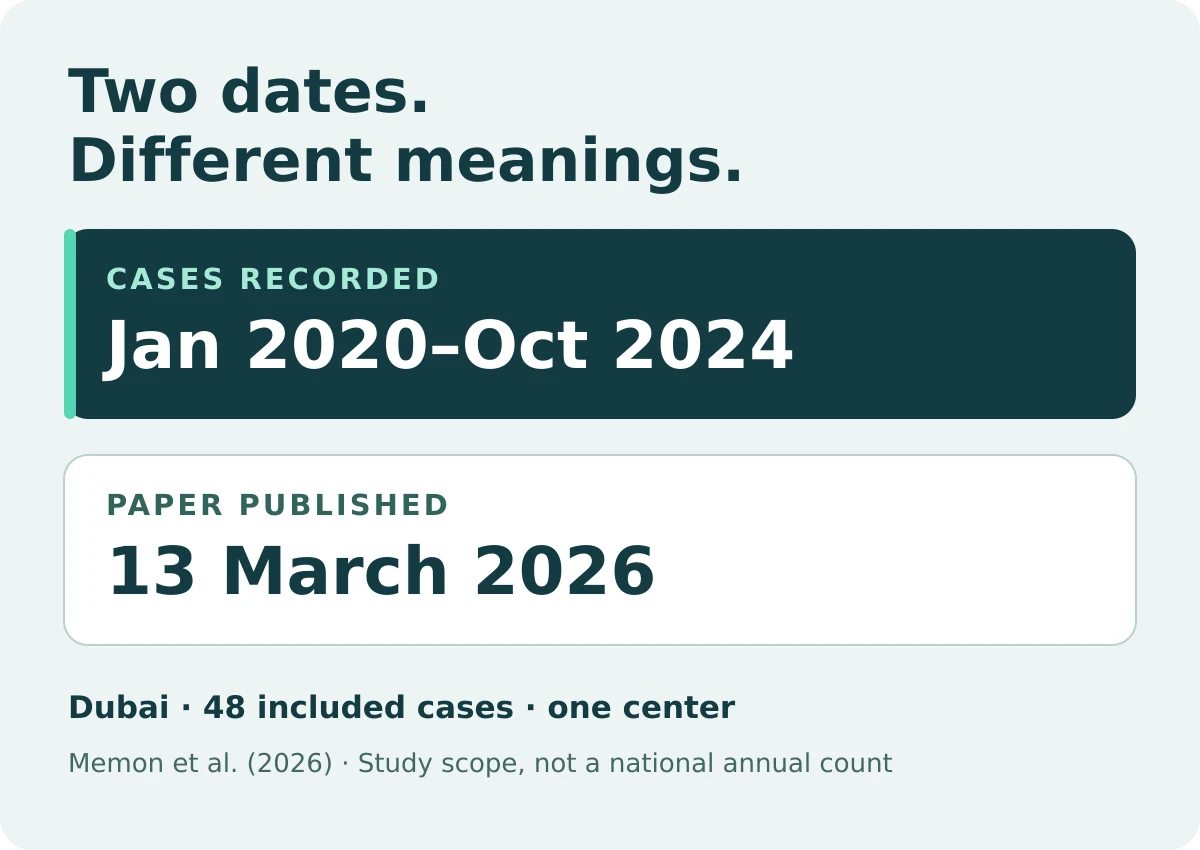
The abstract of Memon and colleagues’ Dubai study, published on 13 March 2026, describes 48 included cases from January 2020 to October 2024 at one healthcare center. Inclusion required a resuscitation attempt and complete records.
The publication year is not the case year, and a selected local sample is not a national count. This guide uses the abstract only for dates and scope. Before quoting or comparing outcomes, obtain the methods, endpoint definitions and follow-up details; its survival results are not compared here.
Source: Memon et al. (2026): Dubai study abstract, dates and inclusion criteria
Keep outcome measures and study status separate
The Bro. Study protocol published in 2024 describes planned observational research at four hospitals across Abu Dhabi, Doha and Muscat. It distinguishes return of spontaneous circulation, survival to admission, survival to discharge and neurological outcomes. These are separate measures, with different assessment points.
The cited publication is a protocol: it describes the research plan and data collection rather than a completed set of outcome results. Its expected publication timetable is not evidence that a final dataset has been published. Check a results paper separately before using any findings.
For your own evidence notes, write the outcome label in full, together with its assessment time and definition. Avoid shortening every outcome to “survival”. An unreported outcome should stay marked as unavailable; it should not become a zero or an estimate.
Source: Farooq et al. (2024): Bro. Study protocol and planned outcome measures
Make a short evidence record before quoting a number
Use the original research record or report, and save the passage or table that supports the proposed claim. The worksheet below is an original editorial aid. Its purpose is to keep the context beside the statistic when the finding moves from a paper into a presentation or purchasing brief.
Write the intended sentence first, then check whether the source supports every part of it. A source may support a historical local count while leaving a national estimate or later outcome unanswered. Narrow the sentence to the evidence available.
| Field | What to retain | Check before reuse |
|---|---|---|
| Source and status | Authors, publication date, link and whether it is a protocol or a results report. | Does the cited document actually report the claimed result? |
| Observation period | The dates when cases were collected. | Has the publication year been mistaken for the case year? |
| Population | Location, service or hospitals, sample size and inclusion rules. | Does the claim expand a local sample into a national population? |
| Denominator | The group used to calculate the percentage, with exclusions and missing records. | Does the percentage still describe the same group? |
| Outcome | The precise endpoint, definition and assessment time. | Has one endpoint been substituted for another? |
| Limits and use | The stated limitations and the exact sentence you intend to publish. | What does this evidence leave unanswered? |
Use evidence to improve planning questions
For an AED proposal, use a sourced local study to explain the context it actually investigated. Ask the responsible programme reviewers how that evidence relates to your site. Keep population statistics separate from the assessment of access, equipment, staff arrangements and maintenance.
Do not use a general study percentage as a promised outcome for one workplace or one AED model. Similarly, an ambulance interval reported for a study population is not a guaranteed response time at your address. A numerical business case needs its own stated assumptions and evidence; multiplying an unsupported survival uplift by an invented cost does not validate a purchase.
Retain unanswered questions in the brief. The related guides below help check product evidence, compare the written offer and assign maintenance responsibilities without turning a research statistic into a product guarantee.
Buyer questions
Does this guide establish how many cardiac arrests occurred across the UAE in 2026?
No. The selected sources do not establish that nationwide total. Their collection periods, service coverage and inclusion rules must remain attached to any figures quoted from them.
Is return of spontaneous circulation the same as survival to discharge?
No. They are different outcomes assessed at different points. Use the exact endpoint and definition reported by the study; missing discharge data cannot be inferred from a ROSC figure.
Can I compare two percentages if both articles concern cardiac arrest?
Check the populations, collection periods, denominators, endpoint definitions and follow-up first. The shared subject alone does not make the figures directly comparable.
Does a study protocol provide completed outcome results?
A protocol describes the planned research. Verify a separately reported results publication before treating an expected sample or publication timetable as observed findings.