Buyer Guide
Comparing AED Models in the UAE: Check the Evidence
By NeoPulse AED Team · Published · Updated
Prepared with AI assistance using the linked sources. Read our editorial policy.
Quick answer
Compare the exact AED model and configuration against the needs recorded by your responsible reviewers. Separate spoken guidance, a timing cue, measured compression feedback and video instructions into different requirements. Ask for the applicable manufacturer document and a demonstration that matches the proposed equipment. Keep unverified features and missing local-market evidence open instead of assigning an unsupported brand ranking.
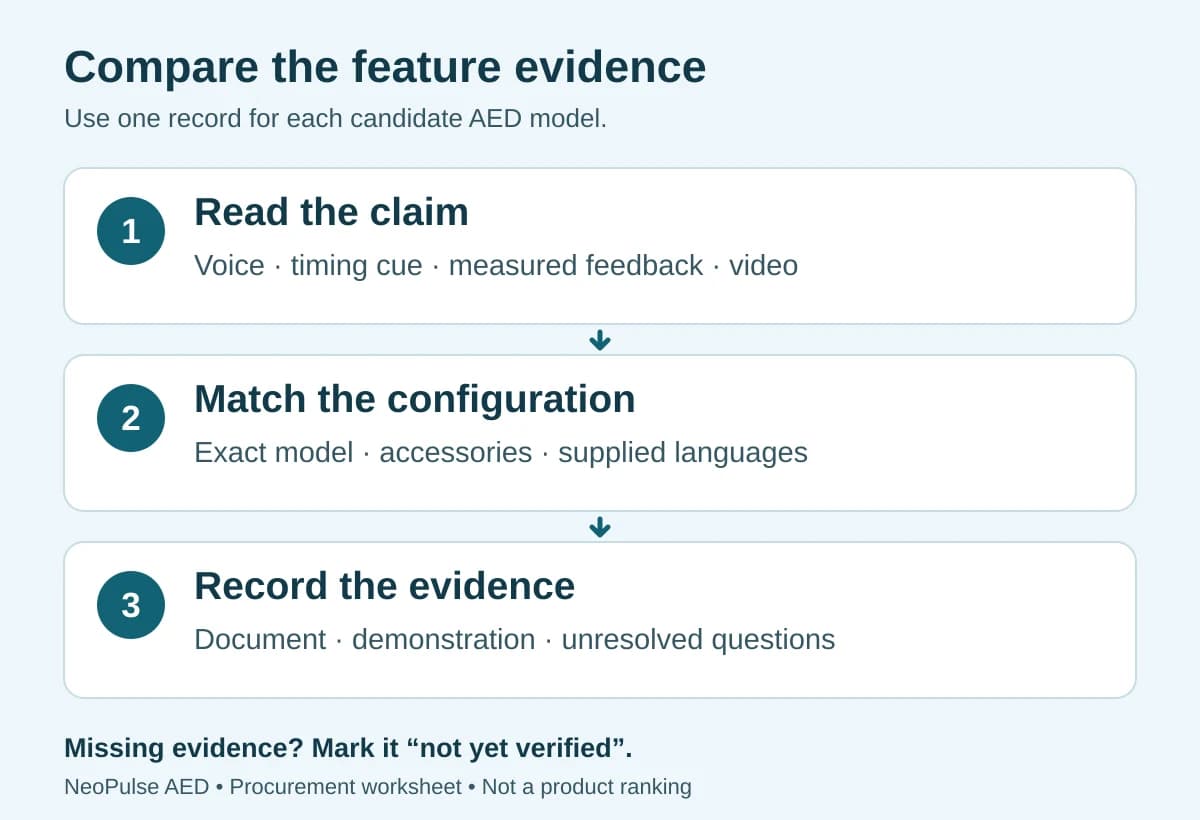
What this comparison covers
Updated 27 September 2026: this guide replaces the earlier article’s unsupported brand rankings, market-exit assertions, language exclusions, prices, ownership-cost calculations, approval claims and support promises. The existing address and original 1 June 2026 publication date are retained.
The three examples below illustrate different feature descriptions in manufacturer documentation. They are not a complete market survey, a clinical comparison or a recommendation that one device is best for every facility. The linked pages are US-market manufacturer pages reviewed for this update; they do not establish UAE authorization, local availability, a supplied language configuration, price or service coverage.
Start by writing the question your team needs to answer. “Does this model provide measured compression feedback with the quoted electrodes?” is more useful than a single yes/no column labelled CPR guidance. Keep the requirement separate from the supplier’s answer and the evidence supporting it.
Example 1: voice guidance and a timing cue
Philips describes the HeartStart FRx as providing spoken instructions and an audible metronome. Its product page identifies pre-connected SMART Pads II and an optional infant/child key. These are descriptions of the FRx configuration on that page, not specifications for every Philips AED.
For a comparison record, give voice instructions and the metronome separate fields. A timing cue alone is not evidence that the device measures compression depth. Ask the supplier to identify the exact model, prompt languages and included accessories in the offer, then point to the applicable instructions.
If a child-use configuration is part of your site brief, ask the responsible reviewer to check the documented configuration and what must be supplied. Do not turn an optional accessory shown on a webpage into an assumed inclusion. This guide provides purchasing questions, not patient-use instructions.
Example 2: measured compression feedback
ZOLL describes Real CPR Help on the AED Plus as real-time feedback about compression depth and rate. The same page describes the CPR-D-padz electrode. Record this measured-feedback claim separately from a metronome or a spoken instruction sequence.
Ask which electrode and device configuration provide the quoted feedback feature. Request the corresponding manufacturer instructions and have the supplier identify the relevant passages. A feature demonstrated with one accessory should not be marked verified for a different package without supporting evidence.
During an agreed training-device demonstration, ask the provider to distinguish the measurements displayed or spoken from general prompts. Record the equipment used and any differences from the proposed supply. A procurement demonstration is not evidence of comparative clinical outcomes or a substitute for formal responder training.
Example 3: video guidance
Defibtech describes the Lifeline VIEW as having a full-color display with video guidance. That description concerns the VIEW model; it should not be carried across to another model because it shares the Lifeline name.
Record visual guidance as its own requirement. Ask for the exact model, software or configuration identifier where applicable, and the available instructions and languages for the offered unit. Have the supplier explain how its demonstration equipment represents that configuration.
If display readability matters at the proposed location, include that question in the site review and request supporting information. A full-color screen description alone does not establish outdoor readability, environmental suitability or that every screen element appears in the requested language.
Use the same evidence worksheet for every model
Create one record per candidate model, with the document title, revision or access date and page or section reference. Use the fields below to turn a sales description into a question that can be checked. This is an original procurement worksheet, not a manufacturer specification table.
Apply the same process to a NeoPulse i5, i7 or i9 offer. Request the exact model’s current instructions, accessory list and supplied configuration. The manufacturer examples above do not verify NeoPulse features, and this comparison does not assign unverified feature scores to those models.
| Feature question | Evidence to record | How to resolve a gap |
|---|---|---|
| What guidance is provided? | Identify voice instructions, timing cues, measured feedback and video separately. | Ask which functions the exact configuration provides; avoid one broad “CPR support” label. |
| What does the feature depend on? | Model identifier, relevant accessory part numbers and applicable instructions. | Request the missing dependency; do not assume the demonstrated package matches the quote. |
| Which languages are supplied? | Written language configuration and the relevant document or demonstration record. | Check spoken prompts and visible text separately; record any unanswered language question. |
| Does it fit the proposed setting? | Site requirements and the applicable device and accessory limits. | Have the responsible reviewer resolve a mismatch; a screen or protection label is not a full site assessment. |
| What has actually been verified? | Document reference, demonstration differences, reviewer and open action. | Mark the item “not yet verified” and assign an owner instead of guessing a score. |
Keep the feature decision separate from the purchasing decision
Agree which requirements are essential before reviewing supplier responses. For each candidate, record whether the supplied evidence answers the requirement, who reviewed it and what remains open. If you use scores, define the scale and the treatment of missing information first; this guide does not provide universal weights.
For example, a supplier might demonstrate video guidance in English while the site brief requests Arabic prompts. Record that the video demonstration occurred and that the requested language configuration still needs verification. Do not conclude from that gap that the whole brand lacks Arabic, or that a translated brochure proves the supplied prompts are Arabic.
After the feature review, check local-market documentation, compatible consumables, written service arrangements and the complete commercial scope using the related guides. A feature shortlist alone does not establish authorization or stock. Retain the final configuration in the order and compare the delivered equipment and documents with that approved record.
Buyer questions
Which AED is best for every UAE workplace?
This guide does not make that claim. Compare documented configurations against your site’s reviewed requirements, then separately confirm the relevant market documents, supply terms and support arrangements.
Are a metronome and measured compression feedback the same feature?
Keep them separate in a procurement comparison. A timing cue does not by itself demonstrate depth measurement. Ask what the exact model and accessory combination measures, and obtain the applicable documentation.
Does a US manufacturer page confirm the UAE language configuration or approval?
No. It can support the specific product feature it describes, but the proposed UAE supply needs its own model, configuration and relevant market evidence. Ask for those documents instead of inferring them from the international product page.
Can I treat a missing feature statement as proof that a brand lacks it?
No. Record it as not yet verified and ask for model-specific evidence. Avoid converting an incomplete supplier response into a claim about every device from that manufacturer.