Buyer Guide
AED Rental vs Buying in the UAE: A Planning Checklist
By NeoPulse AED Team · Published · Updated
Prepared with AI assistance using the linked sources. Read our editorial policy.
Quick answer
Compare rental and purchase offers for the same equipment, location and coverage period. A temporary requirement gives you a reason to request a rental option; expected repeat use gives you a reason to assess ownership as well. Decide using written costs, responsibilities and end-of-term arrangements. There is no universal number of months at which buying becomes cheaper, and a hire fee alone does not show what support is included.
What changed in this guide
Updated 29 September 2026: this guide replaces unsupported rental prices, savings percentages, break-even periods, tax conclusions, legal requirements, model specifications and package guarantees in the earlier article. It retains its existing address and original 15 May 2026 publication date.
Use the checklist to prepare a purchasing brief for a temporary workplace, an event or a continuing facility requirement. Ask your responsible site and procurement reviewers to confirm the equipment requirement and applicable conditions. This guide does not establish a venue’s compliance or prescribe emergency treatment.
Start with the period you need covered
Write down the required delivery and acceptance time, the start of coverage, the final period when equipment is needed, and the proposed collection time. Event opening and closing times alone may leave setup, overnight activity or dismantling outside the brief. Ask the site reviewer to define the actual coverage requirement.
For a project with an uncertain finish date, request the extension process and charging unit before booking. A daily, weekly or monthly price cannot be compared until you know the minimum term, how partial periods are charged and when billing stops.
For a purchase option, identify a real proposed use after this project. Record the receiving site, responsible owner and any further handover or storage work. Do not assume future reuse, resale proceeds or a rental-to-purchase credit that has not been agreed in writing.
- One event: include delivery access, acceptance and collection windows in the brief.
- Repeated events: ask for the total scope across the planned dates, including each transfer.
- Continuing use: compare the same period and support responsibilities for both options.
- Uncertain completion: request written extension, cancellation and early-return terms.
Compare the complete equipment package
The FDA describes an AED system as including the device and necessary accessories such as its battery and pad electrodes. Its accessory listings identify compatible AED models. That US information explains why the complete system matters; it does not establish UAE authorization or the contents of a NeoPulse rental package.
Request the manufacturer, exact model, supplied language configuration and included accessory part numbers for both offers. If the site requires a particular child-use configuration, ask for its documentation and inclusion in the offer. Record any permitted substitution and who must review it before delivery.
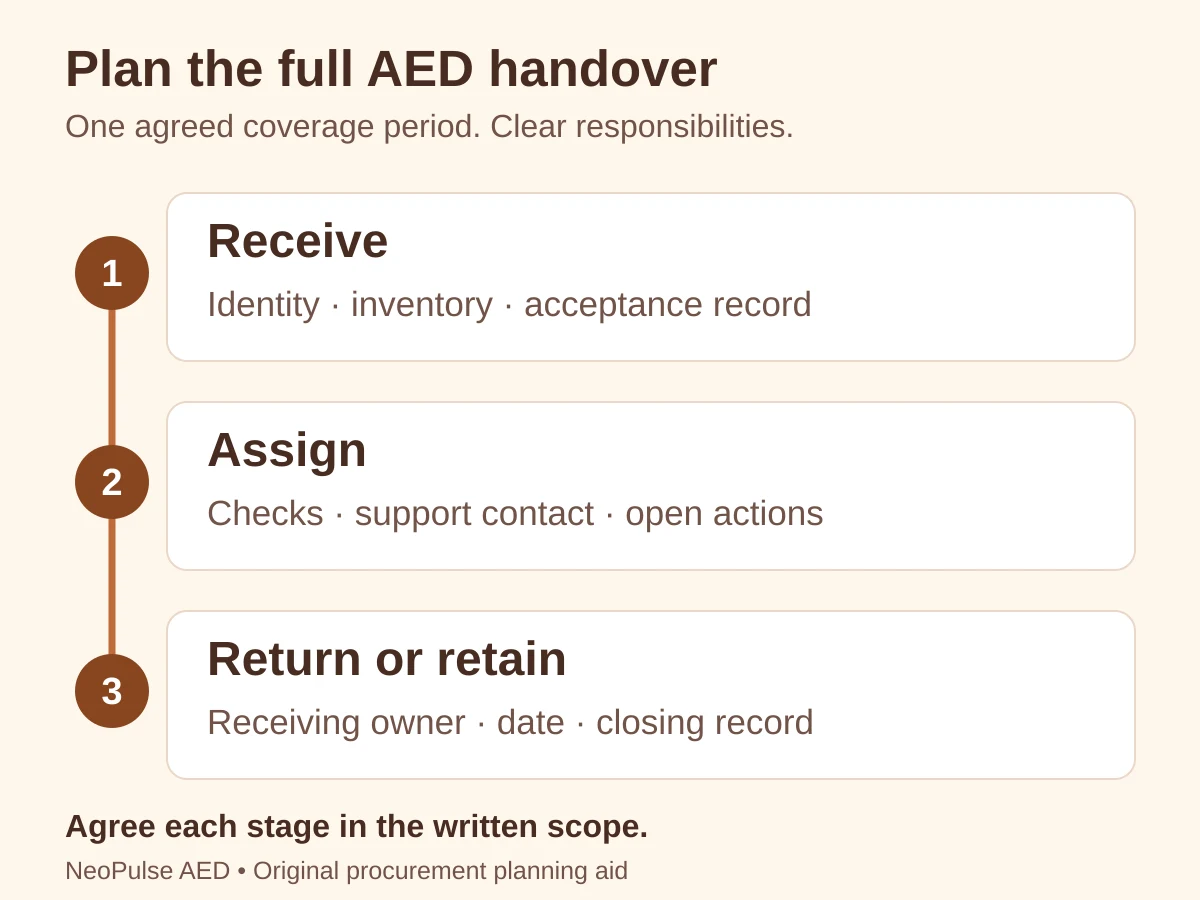
At handover, retain the supplied serial number, accessory inventory, relevant expiry information, applicable instructions and the provider’s documented readiness and condition record. Ask the receiving reviewer to resolve discrepancies against the accepted offer. Use the manufacturer’s instructions for device checks; do not invent a generic power-on test.
Source: FDA: AED systems and compatible accessories (US scope)
Compare documented charges over the same period
Use a rental total and a purchase total covering the same site brief and dates. For each, list the equipment charge and any separately quoted delivery, collection, installation, training, consumables and service charges. Mark an unanswered charge as “not stated”, not zero. This is a quotation worksheet, not a published price benchmark.
Record a refundable deposit separately, including its amount, release conditions and timing. List possible extra charges and the events that trigger them, such as an agreed extension, missing items or replacement consumables. Ask your finance reviewer how to compare payment timing, tax and accounting treatment for the actual arrangement.
Compare a planned end date with a plausible extension using the supplier’s written rates and terms. For ownership, keep any proposed resale or reuse assumption visible rather than subtracting an invented credit. This makes the decision traceable without claiming that rental or purchase always wins after a fixed duration.
| Decision item | Rental offer | Purchase offer |
|---|---|---|
| Coverage period | Hire start, minimum term, billing end and collection window. | Period being compared and the plan for continued use. |
| Equipment and handover | Exact configuration, serial-number record and included items. | Same configuration and acceptance documents. |
| Quoted charges | Hire total, separately priced services and deposit conditions. | Purchase total and separately priced services. |
| Changes to the plan | Extension, cancellation, substitution and early-return terms. | Relocation, further storage, handover or additional support scope. |
| Use or a fault | Reporting contact, review arrangements, replacement terms and charges. | Responsible owner and written service or replacement arrangements. |
| End of this period | Return checklist, collection evidence and deposit review. | Receiving owner, location and continuing responsibilities. |
Assign responsibilities during the covered period
ZOLL’s maintenance guidance directs owners to the manufacturer’s instructions for inspection and to the documented storage limits for the AED and its consumables. It also notes that pad and battery life varies by manufacturer and model. These points support asking for device-specific arrangements; they are not evidence that a rental includes maintenance or that every model has the same interval.
Ask who performs the applicable routine checks, keeps the record, monitors expiry information and reports a problem. Identify the proposed storage location and confirm that it has been reviewed against the supplied equipment’s instructions. A rental agreement should make the provider’s work and the site team’s work clear.
Agree a contact and escalation route for use, damage or a fault, together with the provider’s stated service hours and response terms. Ask who arranges the required equipment review and replenishment, whether a replacement unit is offered, and what charges apply. The site’s responsible team should plan continuity without assuming an immediate swap or round-the-clock support.
Keep equipment orientation separate from formal responder training. If training is requested, record the provider, participants, course scope and completion record in either offer.
Source: ZOLL: manufacturer-directed inspection, storage and consumables
Plan the closing handover before the start
For rental, agree who can release the equipment, the collection location and the items to be returned. Record the unit’s identity, the collection time, the condition record and any open issue. Ask how the provider confirms receipt and resolves the deposit or any additional charge.
If equipment has been used, follow the applicable device instructions and your organization’s procedures. Coordinate the equipment handover with the responsible clinical or incident-review team, including any required handling of device records. Do not put patient information into an ordinary commercial return checklist.
For a purchase, document whether the device stays at the current site or moves to a named receiving owner. Recheck the location and responsibilities for any transfer. If a rental might convert to purchase, request a separate written proposal identifying the unit, price, any credit, warranty and future service scope; no conversion or credit is assumed here.
Keep the final decision with the approved brief, both written offers, unresolved questions and assigned owners. Revisit it when dates, equipment or responsibilities change. Use the rental enquiry page below to request terms for your actual dates and location.
Buyer questions
Is renting always cheaper for a short project?
No universal saving is established here. Compare written offers for the same equipment and dates, including the minimum hire period, transfers, services and any conditional charges.
Does a rental fee include pads, batteries, training and replacement equipment?
Only the written offer can establish its inclusions. Ask for quantities, compatible part numbers, replenishment responsibilities, training scope and any replacement-unit terms before booking.
What should I do if the project end date moves?
Use the agreed extension process and obtain confirmation of availability, revised dates and charges. Update the collection and responsibility records; do not assume the original booking extends automatically.
Must every UAE facility own its AED rather than rent it?
This guide does not establish that rule. Have the responsible reviewer check the requirements applying to your facility and proposed arrangement, using the relevant authority and equipment documents.
Will rental payments be credited if I later buy the device?
Do not assume a credit or conversion right. Request written terms identifying the device, purchase price, any credit and the resulting warranty and support scope.