Workplace Planning
AEDs for Factories and Manufacturing Plants in the GCC
By NeoPulse AED Team · Published
Prepared with AI assistance using the linked sources. Read our editorial policy.
Quick answer
GCC workplace first aid rules scale with headcount. As the workforce grows, they add first aid kits, trained first aiders, nurses, first aid rooms and clinics, but most do not name AEDs. The clearest exception we found is Sharjah’s first aid code of practice, OSHJ-CoP-16. It recommends an AED programme, says the AED must be placed in prominent, accessible areas, and says first aiders must be trained to use it. For a factory, plan AEDs by how quickly a trained person can bring one to every production line, store and yard on every shift, and keep the decision in the first aid risk assessment.
How first aid rules scale with headcount
These summaries show the pattern. Read the full official text for your emirate or country before relying on a number, because the summaries below come from secondary legal databases where noted.
| Where | What the rule requires | AED named? |
|---|---|---|
| Sharjah (OSHJ-CoP-16) | First aid risk assessment; one first aider under 16 employees, two for 17 to 50, then two for the first 50 and every 100 after; a first aid room at 250 or more employees. | Yes: recommends an AED programme, prominent placement and first aider training. |
| UAE (Ministerial Decision 2/37 of 1982, summary) | First aid equipment for smaller establishments; a nurse and a doctor above 50 workers, with wider medical care at 200 or more. | No |
| Qatar (Decree No. 16 of 2005, summary) | A first aid kit for every 25 workers; a trained first aider at locations with 5 to 25 workers; a part-time nurse above 100; a clinic with a doctor and nurse above 500. | No |
| Saudi Arabia (Ministerial Decision 1/400 of 1428H, summary) | A full-time paramedic and an equipped first aid room within 200 metres of the furthest work location at 50 or more workers; an ambulance at 500 or more workers 10 km or more from a health facility. | No |
| Oman | We did not find a public first aid headcount rule when this guide was written. | Not found |
Source: Sharjah OSHJ-CoP-16: First Aid at Work (PDF); GLMM: UAE Ministerial Decision 2/37 of 1982 on medical care for workers (summary); GLMM: Qatar Decree No. 16 of 2005 on medical care for workers in facilities (summary); GLMM: Saudi Ministerial Decision 1/400 of 1428H (summary)
Planning AEDs on the production floor
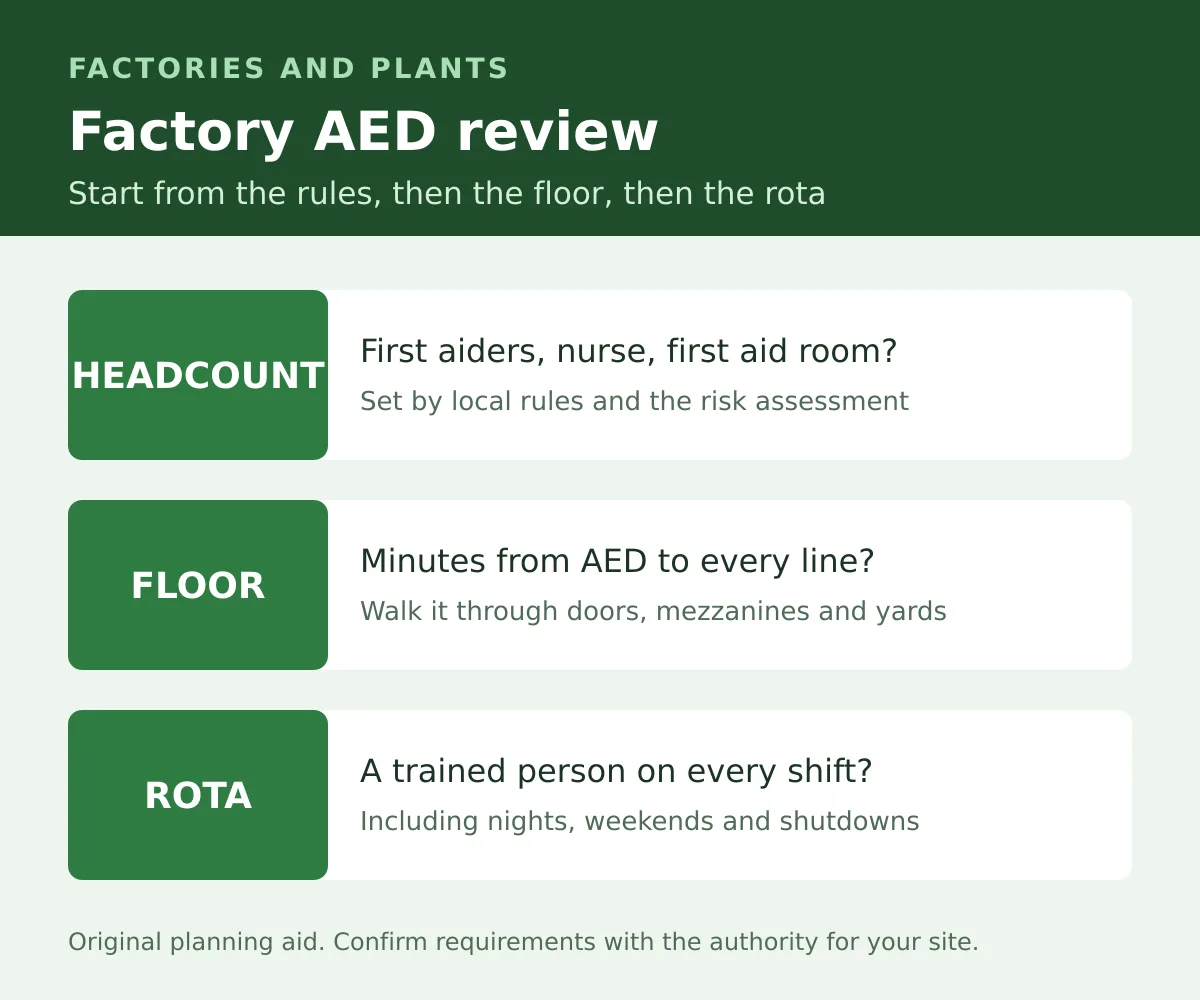
Walk the routes with the HSE lead and a first aider, and time how long it takes to bring an AED to each area. Look for doors that need access cards, stairs to mezzanines and long yards that slow the response.
- First aid room or clinic, if it is staffed or unlocked on every shift.
- Main production halls, especially where lines are far from the first aid room.
- Control rooms, maintenance workshops and utility buildings.
- Canteens, prayer areas and changing rooms where many workers gather.
- Warehouses, loading bays and security gates on large sites.
Shifts, shutdowns and contractors
Many factories run nights and weekends with fewer people. Check that each shift has trained first aiders who know where the AEDs are, and that the first aid room is not the only AED location if it is locked when the nurse is off duty.
During shutdowns and maintenance turnarounds, contractor numbers can rise sharply. Brief contractor supervisors on AED locations and include them in the emergency plan for that period.
Factory AED worksheet
Use this with the plant manager, HSE lead and occupational health provider. It is an original planning aid, not an authority form.
| Check | What to record | Question for the review |
|---|---|---|
| Applicable rule | Emirate or country rule, client or group standard, first aid risk assessment. | Which document sets first aid provision at this headcount? |
| Response time | Measured minutes from each AED to each area, including mezzanines and yards. | Can a trained person bring an AED to every area quickly? |
| Shifts | First aider rota by shift, nurse hours, first aid room opening hours. | Who can use the AED on nights, weekends and during shutdowns? |
| Environment | Manufacturer temperature, dust and water limits; cabinet type. | Is each AED kept within its documented limits, away from heat sources? |
| Training | First aider certificates and AED training on the exact model. | Are first aiders trained on the AED the plant actually has? |
| Checks | Status log, pad and battery expiry, spare set, post-use process. | Who checks the AEDs and replaces pads after use? |
What to ask an AED supplier for a factory
Ask for the exact model’s temperature, dust and water ratings from the manufacturer’s documents, the voice-prompt languages available for your workforce, and whether alarmed cabinets and multilingual signage are available.
Ask for on-site AED training for first aiders on each shift, a schedule for refreshers, and a clear process for replacing pads and batteries. NeoPulse can quote AEDs, cabinets, signage and training for factories and plants in the UAE and the wider GCC; send your headcount, shifts and site layout through the quote form.
Buyer questions
Is an AED required in a UAE factory?
Federal UAE medical care rules for workers that we checked do not name AEDs. In Sharjah, OSHJ-CoP-16 recommends an AED programme based on risk findings or authority requirements. Check your emirate’s rules and your first aid risk assessment.
How many first aiders does a factory need in Sharjah?
OSHJ-CoP-16 sets a minimum of one first aider under 16 employees, two for 17 to 50, and two for the first 50 plus two for every 100 after, with the risk assessment able to require more.
What first aid does Qatar require for factories?
The published summary of Decree No. 16 of 2005 lists a first aid kit per 25 workers, a trained first aider at small locations, a part-time nurse above 100 workers and a clinic above 500. It does not name AEDs.
Where should AEDs go in a factory?
Where a trained person can reach them quickly from every production area on every shift: usually the first aid room plus central points in large halls, workshops and canteens. Time the routes rather than using a fixed ratio.
Does this guide cover oil and gas plants?
Refineries and gas plants are covered in our onshore oil and gas guide. This guide covers general manufacturing.