Compliance
AEDs for Clinics, Dental Centres and Pharmacies in the UAE, Saudi Arabia, Qatar and Oman
By NeoPulse AED Team · Published
Prepared with AI assistance using the linked sources. Read our editorial policy.
Quick answer
Several GCC health regulators already name defibrillators. Oman's Ministry of Health guideline for private health establishments says dental, dermatology, ophthalmology and radiology clinics using only topical anaesthesia should have an AED, a bag-valve mask, an adrenaline pen and BLS certification, with crash carts for higher-risk services. In Dubai, DHA requires portable AEDs in hospital non-patient areas, and the Dubai Healthcare City outpatient standard requires a crash cart with a defibrillator in higher-class clinics. Qatar's QCHP requires BLS with AED training for pharmacists and allied staff. Check the current standard for your regulator and licence class.
UAE: Dubai hospitals, clinics and dental centres
The DHA Standards for the Management of Crash Carts in Hospitals (version 1.1, effective 27 May 2025) require a defibrillator on each crash cart, daily functional checks, and portable AEDs for emergencies in non-patient care areas. Each hospital assesses how many AEDs its non-clinical areas need and fixes them in the nearest locations, and the biomedical department maintains them according to the manufacturer.
In Dubai Healthcare City, the DHCR standard on emergency services in outpatient care settings requires a crash cart in Class B, C and C-M clinics, sedation endoscopy units, dialysis and fertility centres, and clinics that run stress tests. Its equipment list starts with a standard defibrillator, it asks for daily evidence that the defibrillator works, and it recommends paediatric AED pads where children aged 1 to 12 are treated.
The DHA Emergency Medications policy sets emergency medicines for dental clinics and an emergency kit for standalone dermatology, ENT, ophthalmology and cosmetic clinics, but does not mention defibrillators. We have not reviewed every Abu Dhabi, Sharjah and northern emirates standard in this guide.
Source: DHA Standards for the Management of Crash Carts in Hospitals, v1.1 (PDF); DHCR: Emergency Services in Outpatient Care Settings (PDF); DHA Emergency Medications policy (PDF)
Oman: private health establishments
The Ministry of Health's Emergency Crash Cart and CPR Guidelines for private health establishments (MoH/DGPHE/GUD/005, released October 2023) say that establishments providing services under topical anaesthesia only, such as ophthalmology, dermatology, radiology and dental clinics, should have an AED, a bag-valve mask, BLS certification and an adrenaline pen. Establishments with in-patient, ICU, emergency or procedures beyond topical anaesthesia need crash trolleys and advanced certification.
The guideline also asks for a code blue activation system, monthly mock drills with records, a daily recorded check of the defibrillator and the trolley, and BLS, ACLS or PALS certification renewed every two years depending on the role.
Source: Oman MoH: Emergency Crash Cart and CPR Guidelines (PDF)
Qatar: life support training for licensing
Qatar Council for Healthcare Practitioners Circular No. 3/2017 sets the minimum life support courses for licensing and renewal. It says AED training should be included in any BLS or CPR training for staff working in healthcare settings, and lists BLS and AED as the requirement for pharmacists, allied health professionals and traditional and complementary medicine practitioners. Physicians and nurses need higher-level courses.
The circular covers training, not equipment. We did not find a published Qatar rule naming AED equipment for every clinic or pharmacy in this research, so check the facility licensing checklist with the Ministry of Public Health.
Source: QCHP Circular No. 3/2017: required CPR courses (PDF)
Saudi Arabia
We did not find a public Saudi Ministry of Health or accreditation document naming AED equipment for every private clinic, dental centre or pharmacy when this guide was written. Check the licensing requirements for your activity with the Ministry of Health and any accreditation body you work with, and use the same risk-based approach: sedation, procedures, older patients and children all strengthen the case for an AED on site.
Clinic and pharmacy AED checklist
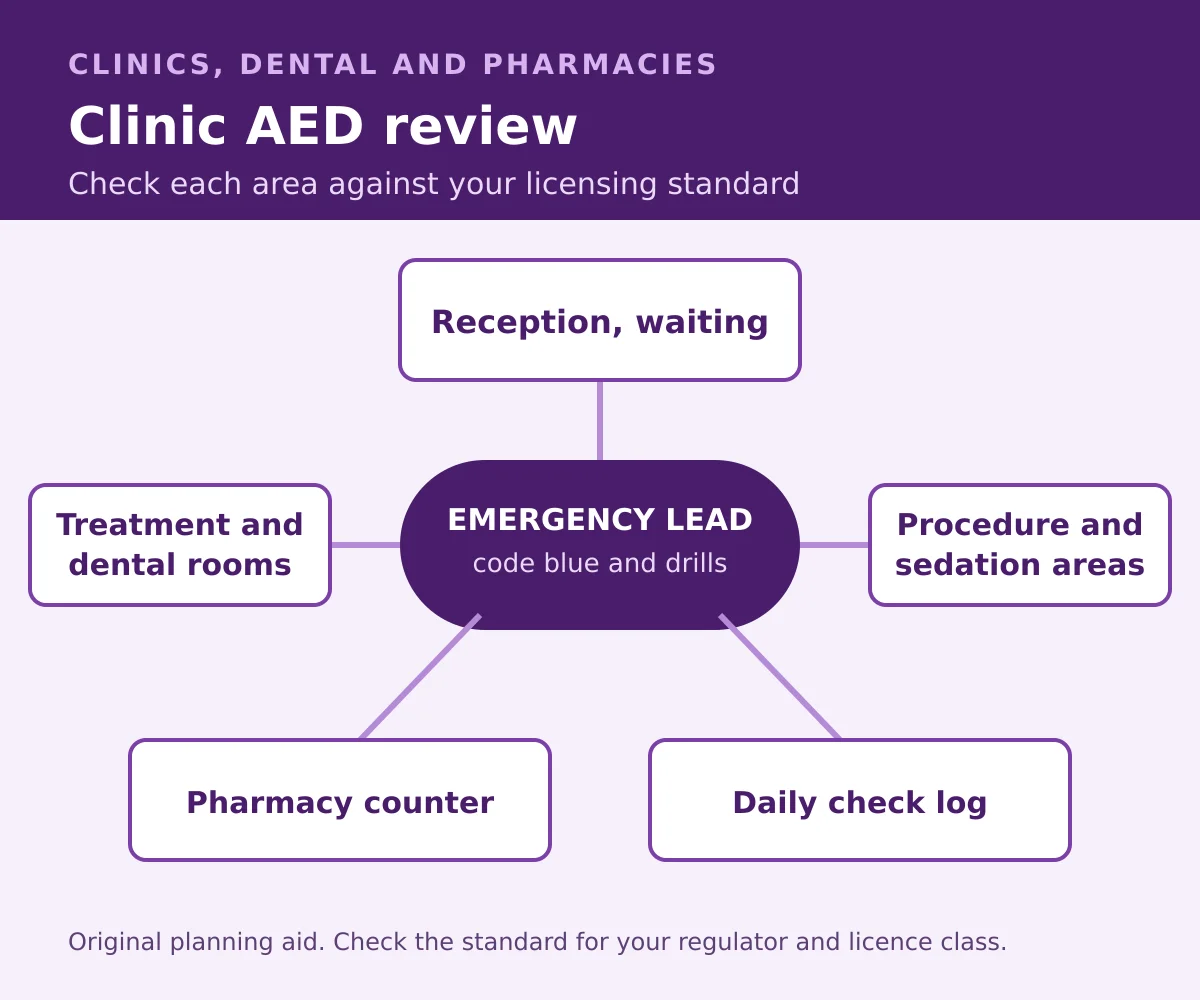
Use this with the medical director and the clinic manager. It is an original planning aid, not an authority form.
| Check | What to record | Question for the review |
|---|---|---|
| Requirement | Regulator, licence class, services such as sedation or stress tests. | Which standard names a defibrillator or crash cart for this facility? |
| Location | AED or crash cart position; route to reception, treatment rooms and waiting areas. | Can staff bring it to any patient or visitor within a few minutes? |
| Children | Paediatric pads or child mode where children are treated. | Are child pads stocked and in date? |
| People | BLS, ACLS or PALS certificates and renewal dates for each role. | Is a certified person on site whenever the clinic is open? |
| Drills | Code blue activation, mock drills and records. | When was the last drill, and what changed after it? |
| Checks | Daily defibrillator check, monthly pad, battery and expiry review. | Who signs the daily log, and who covers weekends? |
What to ask an AED supplier
Ask for the exact model's registration documents for your country, paediatric pad or child mode options, event-data download, self-test and status indicator, and the pad and battery schedule in the manufacturer documents. A clinic that already has a manual defibrillator on its crash cart may still want an AED at reception for visitors.
NeoPulse can quote AEDs, cabinets, signage and staff training for clinics, dental centres and pharmacies in the UAE and the wider GCC. Send your licence class, floors and opening hours through the quote form.
Buyer questions
Do dental clinics in Oman need an AED?
Yes, according to the Oman MoH Emergency Crash Cart and CPR Guidelines for private health establishments: dental clinics using topical anaesthesia should have an AED, a bag-valve mask, an adrenaline pen and BLS certification.
Do Dubai hospitals need AEDs in public areas?
Yes. The DHA crash cart standard for hospitals requires portable AEDs for emergencies in non-patient care areas, with the number based on the hospital's own assessment.
Do Dubai dental clinics need an AED?
The DHA Emergency Medications policy sets medicines for dental clinics but does not mention defibrillators. Check your licensing checklist and decide from a risk assessment.
Do pharmacists in Qatar need AED training?
Yes. QCHP Circular No. 3/2017 lists BLS and AED as the minimum life support course for pharmacists for licensing and renewal.
Is there a page for UAE healthcare facilities?
Yes. See our AED for healthcare facilities in the UAE page for the Dubai standards and planning points.