Planning
AEDs for Residential Towers and Communities in the UAE, Saudi Arabia, Qatar and Oman
By NeoPulse AED Team · Published
Prepared with AI assistance using the linked sources. Read our editorial policy.
Quick answer
Most out-of-hospital cardiac arrests in the region happen at home. A 2025 Qatar national registry study found 64% of 1,238 arrests occurred at home, and a 2023 Riyadh study found 77.5% of 1,011 arrests with a known location occurred at home. We have not found a published GCC rule that requires an AED in every residential building, so the decision usually sits with the developer, owners association, landlord or compound operator. Put AEDs where security or concierge staff can bring one quickly to any floor or villa, train staff and willing residents, and keep a check record.
Why homes matter
A national registry study of out-of-hospital cardiac arrest in Qatar, published in Resuscitation Plus in 2025, included 1,238 adults. Arrests occurred predominantly at home (64.0%), bystander CPR was performed in 42.4% of cases, and survival to hospital discharge was 17.8%.
A cross-sectional study of 1,023 cases in Riyadh province, using Saudi Red Crescent Authority data from June 2020 to May 2021 and published in Frontiers in Cardiovascular Medicine in 2023, found home was the most common location (77.5% of cases with a known location) and bystander CPR was performed in 12.7% of cases.
Neither study reports how often a bystander used an AED. They show where arrests happen, and why trained people and an AED close to homes matter.
Source: Resuscitation Plus (2025): OHCA in Qatar, national registry study; Frontiers in Cardiovascular Medicine (2023): OHCA in Riyadh province
UAE: Dubai Heart Safe City and the 2026 public safety law
Gulf News reported in January 2022 that the Dubai Health Authority, Dubai Police and the Dubai Corporation for Ambulance Services launched Dubai Heart Safe City. At launch, 3,200 AEDs had been provided at locations such as malls, airports and community centres, with plans for 10,000 AEDs in key community areas, CPR training for more than 100,000 people and an app to show the nearest AED and trained person.
Dubai Law No. 2 of 2026 on public safety, announced by the Dubai Media Office in March 2026, covers venues and events, product and service safety and the maintenance of inhabited buildings and homes, and requires first aid supplies at venues and events. The announcement does not mention AEDs. Owners and operators should check the implementing rules as they are issued.
Source: Gulf News: Dubai Heart Safe City launch (January 2022); Dubai Media Office: Law No. 2 of 2026 on public safety
Saudi Arabia, Qatar and Oman
We have not found a published rule in Saudi Arabia, Qatar or Oman that requires an AED in residential towers, compounds or gated communities. Compound operators, developers and employers who house staff often set their own standard, and some residential compounds include clinics, gyms and pools that bring their own requirements. For staff housing, see our labour accommodation guide.
Plan from time, floors and access
In a tower, the slow parts of the route are the lift wait, access-controlled floors and the walk from the security desk. In a compound or gated community, it is the distance between villas, gates and the clubhouse. OSHA's workplace AED guide suggests a target of getting an AED to the person within three to five minutes, which is a useful planning target for homes as well.
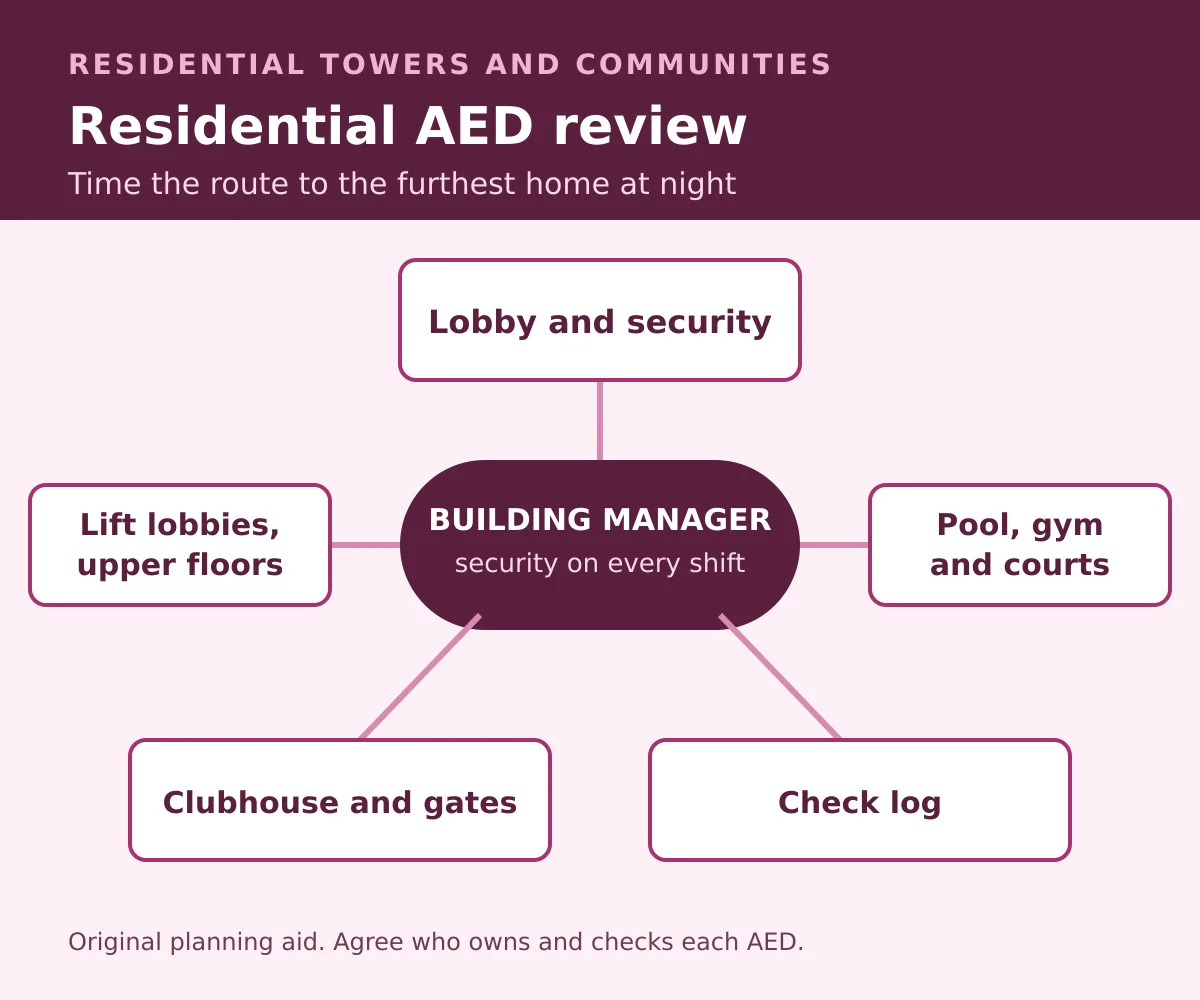
Time a walk from each AED to the furthest apartment or villa at night, including the lift wait. Make sure security or concierge staff can open every cabinet and every access-controlled door, and that residents know the internal emergency number as well as the ambulance number.
- Main lobby or security desk, staffed around the clock.
- Lift lobbies on upper floors of tall towers, or a unit carried by the responding guard.
- Pool, gym and sports courts used by residents.
- Clubhouse, community centre and main gates in compounds.
- Car parks and podium levels if security patrols them.
Source: OSHA 3185: Saving Sudden Cardiac Arrest Victims in the Workplace (PDF)
Residential AED checklist
Use this with the building manager, the owners association or compound operator, and the security contractor. It is an original planning aid, not an authority form.
| Check | What to record | Question for the review |
|---|---|---|
| Decision | Developer, owners association, landlord or operator approval and budget owner. | Who owns the AEDs and who pays for pads, batteries and training? |
| Location | AED positions and timed routes to the furthest apartment or villa. | Can a guard bring an AED to any home within a few minutes at night? |
| Access | Cabinet codes, access-controlled floors and gate procedures. | Can the responder and the ambulance crew reach every floor and villa? |
| People | Security and concierge training dates; resident volunteers. | Is a trained person on duty on every shift? |
| Alerting | Internal emergency number, ambulance number and who meets the crew. | Do residents know whom to call first? |
| Checks | Status indicator, pad and battery expiry dates and a signed log. | Who checks the units, and who replaces them after use? |
What to ask an AED supplier
Ask for the exact model's registration documents for your country, the voice prompt languages, child pads or child mode for family communities, the status indicator and self-test, outdoor cabinet options for pools and gates, and the pad and battery schedule in the manufacturer documents.
NeoPulse can quote AEDs, cabinets, signage and staff training for residential towers, compounds and gated communities in the UAE and the wider GCC. Send the number of buildings, floors, villas and security posts through the quote form.
Buyer questions
Where do most cardiac arrests happen in the Gulf?
At home, according to two regional studies: 64% of arrests in a 2025 Qatar national registry study and 77.5% of arrests with a known location in a 2023 Riyadh study.
Is an AED required in a residential building in Dubai?
We have not found a published rule that requires one. Dubai's 2026 public safety law covers the maintenance of inhabited buildings and first aid supplies at venues and events, but the announcement does not mention AEDs.
Who should hold the AED in a tower?
Usually the security or concierge team, who are on duty around the clock and can reach every floor. Train them, and invite willing residents to CPR and AED sessions.
How many AEDs does a compound need?
Plan from time. Time the walk or drive from each AED to the furthest villa at night and add units where it takes too long. A target of three to five minutes is a useful guide.
Is there a guide for staff accommodation?
Yes. See our labour accommodation and worker camp AED guide.