Compliance
AEDs for Offices and Corporate Towers in the UAE, Saudi Arabia, Qatar and Oman
By NeoPulse AED Team · Published
Prepared with AI assistance using the linked sources. Read our editorial policy.
Quick answer
Most GCC workplace first aid rules set first aid boxes, trained first aiders and first aid rooms by headcount, and few name AEDs for every office. Sharjah's OSH Code of Practice 16 and Abu Dhabi's OSHAD Code of Practice 4.0 both recommend an AED programme based on risk assessment or authority mandates, with first aiders trained in its use. Saudi Ministerial Decision 400/1 and Qatar's Decree No. 16 of 2005 set first aiders, first aid rooms and clinics by workforce size without naming AEDs. In a tower, plan from time: an AED a trained person can bring to any desk within a few minutes, including floors served only by lifts.
UAE: Sharjah and Abu Dhabi codes of practice
Sharjah's OSH Code of Practice 16 on first aid sets one first aid box for every 100 employees, a first aid room where there are 250 or more employees, and a table of first aider numbers: one below 16 employees, two from 17 to 50, and more for every further 100. Clause 5.2.2 recommends that the entity establish an automated external defibrillator programme based on risk assessment findings and/or as mandated by relevant authorities. Where an AED is provided, first aiders are trained in its use, it is placed prominently and the manufacturer's manual is followed. First aid training, including AED use, is refreshed within two years.
Abu Dhabi's OSHAD Code of Practice 4.0 on first aid and medical emergency treatment also says employers should consider an AED programme based on risk assessment or authority mandates, with written responsibilities, physician oversight, training and manufacturer-directed maintenance.
We have not found a published rule that names AEDs for every office in Dubai or the northern emirates. Landlords, free zone authorities, tenant fit-out guides and group policies often set their own requirement, so ask for the clause in writing.
Source: Sharjah OSHJ Code of Practice 16: First Aid (PDF); Abu Dhabi OSHAD-SF Code of Practice 4.0: First Aid and Medical Emergency Treatment (PDF)
Saudi Arabia: Ministerial Decision 400/1
Ministerial Decision No. 400/1 on first aid and medical care at the workplace, published by the Ministry of Human Resources and Social Development in an unofficial English translation (the Arabic text prevails), sets a full-time first aider where there are 50 or more workers, a first aid room within 200 metres of the farthest workplace, stretchers, and an ambulance for larger sites far from a health unit.
The decision does not name AEDs. A building operator, landlord or client may still require one, and the first aid room distance is a useful reminder to plan from walking time.
Source: HRSD: Ministerial Decision 400/1, unofficial translation (PDF)
Qatar: Decree No. 16 of 2005
Decree No. 16 of 2005 on medical care for workers in facilities, as summarised by the Gulf Labour Markets and Migration programme, sets a first aid kit for every 25 workers, a trained first aider, a part-time nurse above 100 workers and a clinic with a doctor and nurse above 500. The summary does not name AEDs. We read the summary, not the official Arabic text, so check the current version with the Ministry of Labour.
Source: GLMM: Decree No. 16 of 2005 on medical care for workers
Oman
We have not reviewed an Omani workplace rule that names AEDs for offices for this guide. Check the occupational safety and health regulation that applies to your company, and any requirement from your landlord or parent group.
Plan from time, not floor area
The US Occupational Safety and Health Administration's guide to AEDs in the workplace notes that the chance of survival falls with every minute without defibrillation and suggests a target of getting an AED to a victim within three to five minutes. In a tower, the slow part of the route is often the lift, the security gate or a locked floor, not the corridor.
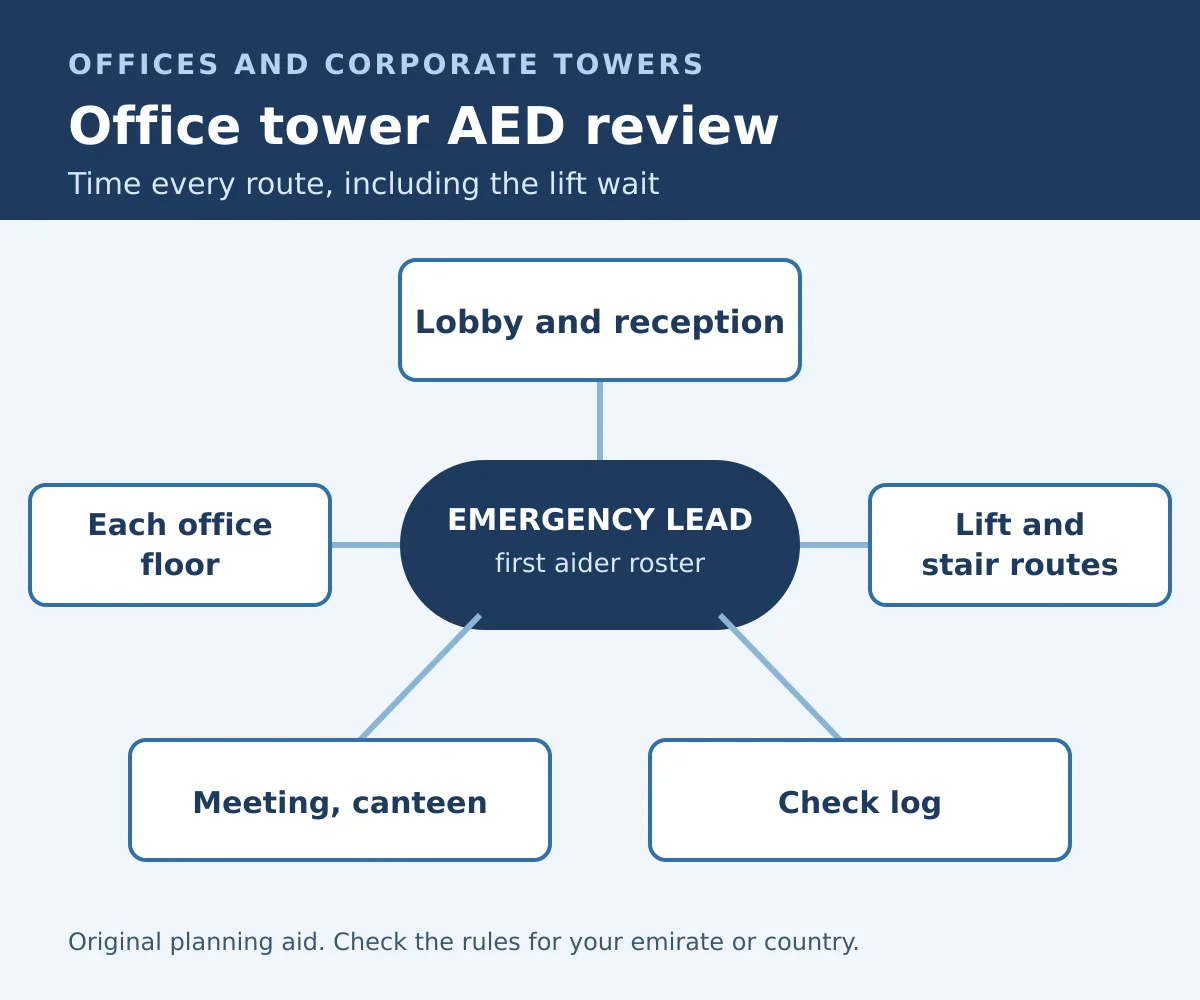
Time a walk from each AED to the furthest desk, meeting room and canteen on every floor it serves, including the lift wait at a busy hour. Add units where the round trip is too long, and check that the cabinet and the route stay open at night and at weekends when only security staff are on site.
- Lobby or main reception, where security staff are on duty around the clock.
- Each office floor, or every second or third floor where lifts are fast and staffed.
- Canteens, gyms and large meeting or event rooms inside the building.
- Car park levels and loading bays, if staff or visitors use them heavily.
- Signage at lift lobbies showing where the nearest AED is.
Source: OSHA 3185: Saving Sudden Cardiac Arrest Victims in the Workplace (PDF)
Office and tower AED checklist
Use this with the facility manager, the tenant HSE lead and building security. It is an original planning aid, not an authority form.
| Check | What to record | Question for the review |
|---|---|---|
| Requirement | Emirate or country code, free zone, landlord and group policy. | Which document names an AED or an AED programme for this building? |
| Location | AED positions, floors served and timed routes including lifts. | Can a trained person bring it to any desk within a few minutes? |
| People | First aiders per shift, AED training dates and refresh dates. | Is a trained person on site at night, at weekends and on Fridays? |
| Responsibility | Which tenant or the landlord owns each unit. | Who checks the unit on shared floors and in the lobby? |
| Alerting | How staff call security and the ambulance, and who brings the AED. | Does the emergency plan name the person who fetches it? |
| Checks | Status indicator, pad and battery expiry dates. | Who signs the check log, and who covers holidays? |
What to ask an AED supplier
Ask for the exact model's registration documents for your country, the voice prompt languages, child mode or pads if children visit, the status indicator and self-test, and the pad and battery schedule in the manufacturer documents. For multi-tenant towers, ask how cabinets, signage and checks will be shared between the landlord and tenants.
NeoPulse can quote AEDs, cabinets, signage and staff training for offices and corporate towers in the UAE and the wider GCC. Send the number of floors, staff per shift and opening hours through the quote form.
Buyer questions
Is an AED required in UAE offices?
We have not found a published UAE rule that names AEDs for every office. Sharjah's OSH Code of Practice 16 and Abu Dhabi's Code of Practice 4.0 recommend an AED programme based on risk assessment or authority mandates. Landlords and group policies may require one.
Do Saudi workplace rules mention AEDs?
Ministerial Decision 400/1 sets first aiders, a first aid room within 200 metres of the farthest workplace and stretchers, but does not name AEDs.
How many AEDs does an office tower need?
Plan from time. OSHA suggests a target of getting an AED to a victim within three to five minutes. Time each route, including lift waits, and add units where it takes too long.
Who should be trained in an office?
Your first aiders on every shift, security staff, receptionists and floor wardens. Sharjah's Code of Practice 16 includes AED use in first aid training and asks for refresher training within two years.
Is there a page for offices in Dubai?
Yes. See our AED for offices in Dubai page for local planning points and a quotation.