Technology
Understanding AED Technology: Features Buyers Should Verify
By NeoPulse AED Team · Published · Updated
Prepared with AI assistance using the linked sources. Read our editorial policy.
Quick answer
When comparing AED technology, separate three questions: how the quoted device delivers a shock, what its CPR support actually measures, and what any connected service reports. Ask for the exact model, configuration, accessory list and current manufacturer instructions. A voice prompt, a feedback sensor and a remote status report describe different functions; record the evidence for each feature before treating it as included.
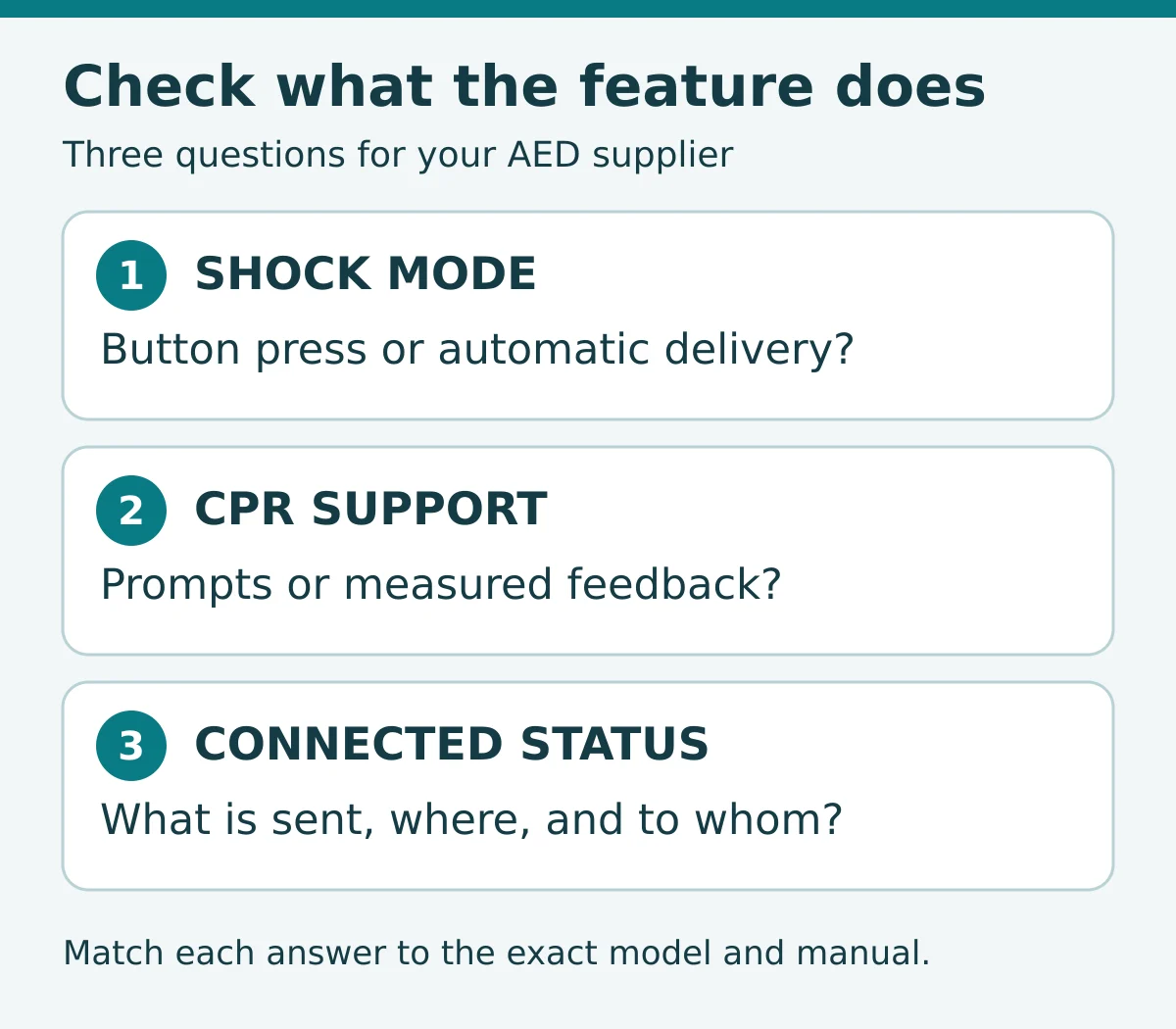
What this technology guide covers
Updated 12 October 2026: this guide replaces an unverified medical byline and unsupported NeoPulse approval, performance and survival claims with sourced explanations and buyer questions. The original publication date and address are retained. No named clinician is presented as its author or reviewer.
Use it to prepare a purchasing review or supplier demonstration. It is not a rescue procedure, a comparison of clinical outcomes or confirmation that a particular NeoPulse model has the example features below. Consult the supplied device instructions and appropriate training for use of the equipment.
Identify the shock mode of the quoted model
The FDA describes an AED as a device that analyses heart rhythm and delivers a shock when appropriate. Its explanation distinguishes semi-automated devices, which prompt the user to press a shock button, from fully automated devices, which deliver the shock when commanded by their software without that button press.
Ask the supplier to identify the version on the quotation and point to the matching instructions. Do not use the word automatic alone to decide which version you are buying. Include the correct training equipment and familiarisation arrangements in the review.
The FDA source is US information. It does not establish UAE authorization for a quoted device; review local product evidence separately.
Source: FDA: AED types, systems and accessory records (United States)
Distinguish CPR prompts from measured feedback
Ask what a proposal means by CPR guidance: spoken instructions, a pacing tone, a display, measurement of compressions, or a combination. A useful demonstration should show which information is measured and which is a preset prompt.
For a documented example, ZOLL describes its AED 3 Real CPR Help feature as providing feedback on compression rate and depth. That statement concerns the named ZOLL product on its UK page; it is not evidence about another model or a guarantee of the configuration offered in the UAE.
- Which pad set or sensor is needed for the described feedback, and is it included?
- Does the feature operate in the intended adult or paediatric configuration? Ask for the relevant manual section.
- Which languages and visual prompts are enabled on the supplied unit?
- Can the supplier demonstrate the agreed functions with suitable training equipment?
Source: ZOLL AED 3: manufacturer feature descriptions (UK page)
Clarify what connected monitoring reports
ZOLL lists optional Wi-Fi connectivity for AED 3 status monitoring. A buyer should therefore check both the equipment configuration and any service needed to receive those reports.
Ask what is transmitted, where it appears, who receives an alert and what happens when connectivity is lost. Distinguish a device-status message from event-data transfer and from emergency-service notification. Do not infer an ambulance-dispatch service from a Wi-Fi logo or the phrase connected AED.
- Record required network access, account ownership and any subscription or renewal terms.
- Name the person responsible for responding to reports and checking unresolved faults.
- Request a documented handover check for the purchased service; retain its result with the configuration record.
Source: ZOLL AED 3: manufacturer feature descriptions (UK page)
Use a feature-verification worksheet
Send the same worksheet to shortlisted suppliers. It is an original purchasing aid, not a technical specification for all AEDs. Keep unresolved items open rather than filling gaps from another device in the same brand family.
| Feature or claim | Question for the supplier | Evidence to retain |
|---|---|---|
| Shock delivery | Which exact model and shock mode are supplied? | Model identifier, configuration and matching manual section. |
| CPR support | Which prompts or measurements are available, and with which accessories? | Feature description, accessory identifiers and training demonstration notes. |
| Connected functions | Which reports are sent, to whom, and under what service terms? | Network requirements, service scope and named report owner. |
| Performance figures | What does a quoted accuracy, analysis-time or energy figure measure? | Manufacturer document, test conditions and applicability to the offered configuration. |
| Consumables and environment | Which pads and battery are compatible, and what storage limits apply? | Accessory list, expiry information and device-specific instructions. |
Keep readiness checks tied to the device instructions
ZOLL’s maintenance guidance directs owners to the manufacturer’s storage limits and device manual, and notes that pad and battery life varies by model. Avoid applying a single replacement interval or temperature range to every device in a comparison.
Use the quoted model’s instructions to identify what its self-tests cover, how status is shown and which checks a responsible person must perform. Keep access to the cabinet and ownership of follow-up actions in the site plan as well.
The FDA treats the battery and pad electrodes as parts of the AED system. Match the accessory identifiers to the model; a similar-looking pad connector or product name is not a sufficient purchase check.
Source: ZOLL: maintenance, storage and consumable guidance; FDA: AED types, systems and accessory records (United States)
Turn the feature list into a handover record
For an illustrative example, a proposal may list connected monitoring while the quoted unit and service schedule do not identify the connectivity option. Keep that feature pending until the supplier resolves the configuration and service scope in writing. This is a review example, not a finding about a supplier.
At handover, keep the final model and accessory list, manual revision, agreed feature demonstrations, training arrangements and support contact together. If a feature was a condition of purchase, record who verified it and the supporting evidence. Use the linked approval and quotation guides for the remaining procurement checks.
Buyer questions
Does automatic mean the AED has no shock button?
Not necessarily. Confirm whether the exact version is semi-automated or fully automated and read its instructions. The FDA distinguishes those versions by whether the user is prompted to press a shock button.
Do voice prompts prove that compression depth is measured?
Ask which variable is measured and which accessory provides that function. Record the manufacturer’s description and demonstration result rather than inferring a measurement feature from spoken instructions alone.
Does a connected AED automatically call an ambulance?
Do not assume that from a connectivity claim. Ask the supplier to document the actual service, recipients, setup and limitations. Device-status reporting and emergency-service notification should be reviewed separately.
Can I compare models using one advertised accuracy or speed figure?
Request the source document, definition, test conditions and exact configuration for each figure. Do not treat differently defined measurements as equivalent or use them to promise an individual clinical outcome.
Does this guide verify NeoPulse features or approval status?
No. It provides questions and identified source examples. Verify the exact NeoPulse model, included features, accessories and applicable approval records from current supporting documents.